
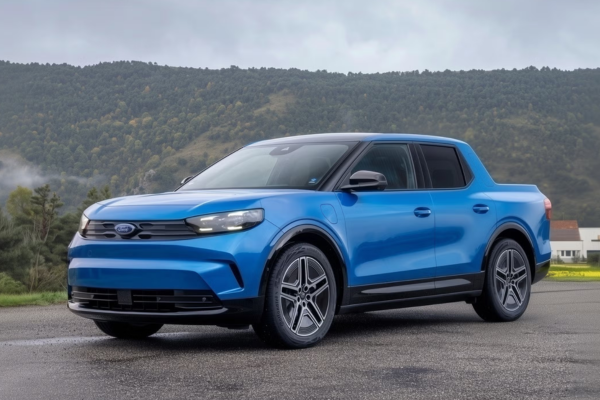
Ford is preparing to reshape the electric pickup market with a new compact model designed to make electric trucks more affordable and practical for everyday drivers. Fresh prototype images suggest the upcoming pickup is significantly smaller than many expected, signalling a shift away from oversized electric trucks towards vehicles built for daily use.
Recent spy photographs captured the heavily camouflaged prototype driving alongside a Ford Expedition, offering the clearest indication yet of its size. Instead of resembling the full-size F-150 Lightning, the new model appears much closer in dimensions to the Ford Maverick, with a lower ride height and a more urban-friendly design.
The compact proportions could prove to be one of the truck’s biggest strengths. Smaller vehicles are generally easier to park, simpler to manoeuvre through busy streets and cheaper to operate. For many buyers, especially those who rarely tow heavy loads, a midsize electric pickup could offer the right balance between practicality and efficiency.
Ford has confirmed that the new pickup will arrive in 2027 and will be built on its all-new Universal EV Platform. The company expects the truck to start at around $30,000, making it one of the most affordable electric pickups expected to reach the market.
If Ford delivers on that target, the vehicle could significantly expand access to electric mobility. According to the International Energy Agency (IEA), global electric vehicle sales surpassed 17 million units in 2025, accounting for more than one in every five new cars sold worldwide. However, affordable electric pickups remain limited, leaving a major gap in the market.
The prototype also reveals several modern design features. Images show a four-door cabin, a large central touchscreen, a prominent front camera integrated into the grille and a rear roof spoiler designed to improve aerodynamic performance. These features suggest Ford is prioritising both technology and efficiency.
Earlier teaser footage hinted at a digital-first cabin after hidden QR codes placed on the prototype directed viewers to a secret Ford webpage showcasing parts of the vehicle’s interior. The large infotainment display appears to be one of the centrepieces of the cabin.
Ford says the compact truck will provide interior space comparable to a Toyota RAV4 despite its smaller exterior dimensions. That combination could appeal to families, small business owners and urban drivers looking for the versatility of a pickup without the size of a traditional full-size truck.
The company is also introducing several manufacturing innovations aimed at lowering production costs. These include megacasting technology and lithium iron phosphate (LFP) batteries, which are generally cheaper, longer-lasting and less dependent on expensive raw materials than conventional lithium-ion batteries.
Battery technology remains one of the biggest drivers of EV affordability. Across the global industry, manufacturers are investing heavily in lower-cost battery chemistry. Companies such as CATL and Changan have already begun producing sodium-ion batteries, another technology expected to reduce EV prices in the coming years.
Ford’s upcoming pickup will also become the company’s first electric vehicle equipped with a native North American Charging Standard (NACS) charging port. The move gives owners direct access to one of North America’s largest charging networks without requiring additional adapters, making long-distance travel more convenient.
Aerodynamics also play a major role in the truck’s development. Saleem Merkt, Ford’s Senior Manager for Advanced EV Aerodynamics, says the vehicle is expected to deliver more than 15% better aerodynamic efficiency than any pickup currently on the market. Improved airflow reduces energy consumption, helping extend driving range while lowering running costs.
For consumers, the financial benefits extend beyond the purchase price. Electric vehicles generally cost less to maintain because they require no oil changes and have fewer mechanical components than petrol or diesel-powered vehicles. Charging at home can also cost considerably less than refuelling with petrol, depending on electricity prices.
Ford appears to have recognised that many drivers want practicality rather than sheer size. Instead of building another premium electric pickup aimed at a niche audience, the automaker is focusing on affordability, efficiency and everyday usability.
If the company succeeds, the new compact pickup could become one of the most significant electric vehicle launches of 2027. It has the potential to attract first-time EV buyers, urban families, small businesses and pickup owners looking for a vehicle that is easier to own, easier to drive and significantly cheaper to operate.
Read also: Ford’s Spain plant could become Geely’s first European EV base




![Tesla [Reuters]](https://autojournal.africa/wp-content/uploads/2026/04/Tesla-Reuters-350x250.png)