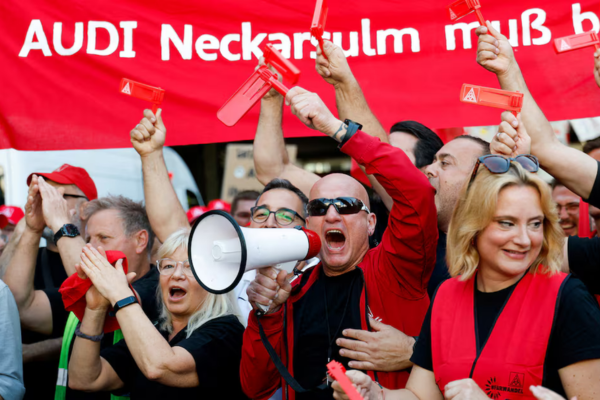
Thousands of Audi employees marched through Neckarsulm on Wednesday after warnings that their factory could be among Volkswagen’s German plants facing closure after 2030, highlighting growing concerns over job cuts, electric vehicle manufacturing, and the future of Germany’s automotive industry.
Around 6,000 workers joined the protest, according to the site’s works council, as uncertainty continues over Volkswagen’s restructuring plans. The company has said the Neckarsulm factory could close if no long-term alternative is found.
“We are scared of factories closing and endangering our future,” Audi worker Melih Cevlik said during the demonstration.
The protest comes as Germany’s automotive sector faces mounting pressure from rising operating costs, stronger competition from Chinese manufacturers and U.S. tariffs. On the same day, rival premium carmaker BMW announced thousands of job cuts, adding to concerns across the country’s manufacturing industry.
Workers Demand Clarity Over Volkswagen Plans
Volkswagen Chief Executive Oliver Blume has previously identified Neckarsulm as one of four German plants that could face closure after 2030 if no viable solution emerges. While the company has discussed alternatives—including defence partnerships and producing Volkswagen’s Chinese models in Germany—no final decision has been made.
“The staff wants clarity because they’re worried about coming to work. Many families are worried, too,” Audi trainee Frank Wojko said during the protest.
Negotiations between Volkswagen management and labour representatives are expected to intensify during the second half of the year. Reports indicate the group is considering increasing planned workforce reductions to 100,000 jobs.
Electric Vehicle Production Seen as Possible Lifeline
The Neckarsulm facility employs around 15,000 people and produces the Audi A5, A6 and A8 models, alongside low-volume production of the all-electric Audi e-tron GT.
Alexander Reinhart, head of the site’s works council, said assigning a high-volume electric vehicle to the factory could strengthen its long-term future.
Audi has already announced plans to cut up to 7,500 jobs in Germany by 2029, mainly in administration and development, after weaker sales in China and limited U.S. manufacturing capacity left the company exposed to tariffs.
Local mayor Steffen Hertwig warned that shutting the plant would have consequences far beyond Audi.
“It would be a disaster,” Hertwig told Reuters, saying the closure could trigger wider economic problems across Baden-Wuerttemberg, home to several major automotive manufacturers and suppliers.
Read also: Audi expands China bet with SAIC as EV competition intensifies

![Boeing 737 max [Photo Credit BusinessInsider]](https://autojournal.africa/wp-content/uploads/2023/08/Boeing-737-max-Photo-Credit-BusinessInsider-75x75.jpg)