After years of waiting, the Range Rover has finally entered the electric vehicle market. For the 2027 model year, the luxury SUV gets its first charging port in its 57-year history.
The new Range Rover Electric keeps the familiar shape and luxury of its gas-powered sibling while adding a dual-motor electric powertrain, a large battery and fast charging. It starts at $140,550, compared with $115,750 for the base gas model.
Range Rover Electric brings 542 horsepower
The new SUV uses two electric motors that produce 542 horsepower and 627 pound-feet of torque. Land Rover says it can reach 60 mph in 4.3 seconds.
The vehicle also uses full-time all-wheel drive and an adjustable air-spring suspension. That combination is designed to keep the smooth ride expected from a Range Rover while adding the instant response of an electric powertrain.
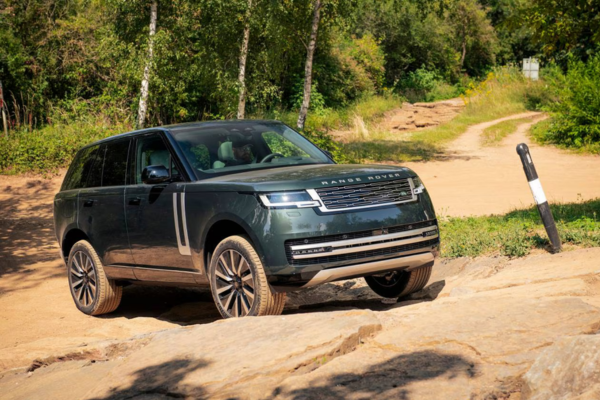
A brief test drive at Land Rover’s facility in Gaydon, United Kingdom, also showed that the SUV can handle light off-road terrain.
The electric motors can respond to wheel spin in as little as 50 milliseconds, according to Land Rover. The company says this is 100 times faster than its combustion-engine system.
Luxury electric SUV keeps its off-road identity
Going electric has not removed the Range Rover’s focus on off-road driving.
The Range Rover Electric can wade through up to 35 inches of water, matching the capability of the gas-powered model. Its air suspension can also raise the vehicle to help clear obstacles.
The vehicle does not have a low-range gearset, but its electric motors produce enough torque that it is not needed, according to the test-drive account provided.
A single-pedal driving mode also gives drivers more control on slopes. The system can provide up to 0.2 g of braking, helping mimic the engine braking found in traditional off-road vehicles.
The SUV also has 7.3 degrees of rear steering, adding to its maneuverability.
EV battery and charging technology
The Range Rover Electric uses a 119-kWh battery and an 800-volt architecture.
Its EPA-estimated driving range is 333 miles on a full charge. The vehicle can accept up to 350 kW from a DC fast charger.
Land Rover says the battery can charge from 10% to 80% in 22 minutes. It also says drivers can add 125 miles of range in 10 minutes.
A NACS charging port comes standard.
Inside, the EV remains almost identical to the gas-powered Range Rover. A smartphone app will allow owners to remotely control the climate, activate the air purifier and check driving range.
Luxury SUV pricing starts above the gas model
The biggest question for buyers may be price.
The Range Rover Electric starts at $140,550, or $24,800 more than the $115,750 base gas model.
However, the difference is smaller compared with the $131,350 plug-in hybrid P550e. The EV costs $9,200 more than that model.
For buyers seeking more customization, the Range Rover Electric will also be available through Land Rover’s Bespoke customization program.
The First Edition will be offered in Belgravia Green, Santorini Black and Varesine Blue, with a Light Cloud interior and Ultrafabric upholstery.
The early driving experience was positive, but the test drive was brief. The bigger question now is whether the Range Rover Electric can deliver its estimated range and off-road performance in everyday driving.
For an icon that took years to go electric, the real test is no longer whether Range Rover can build an EV. It is whether the electric Range Rover can make buyers feel that nothing important was lost in the transition.
Read also: Range Rover Expands into Luxury EV Segment with Low-Slung GT Prototype