
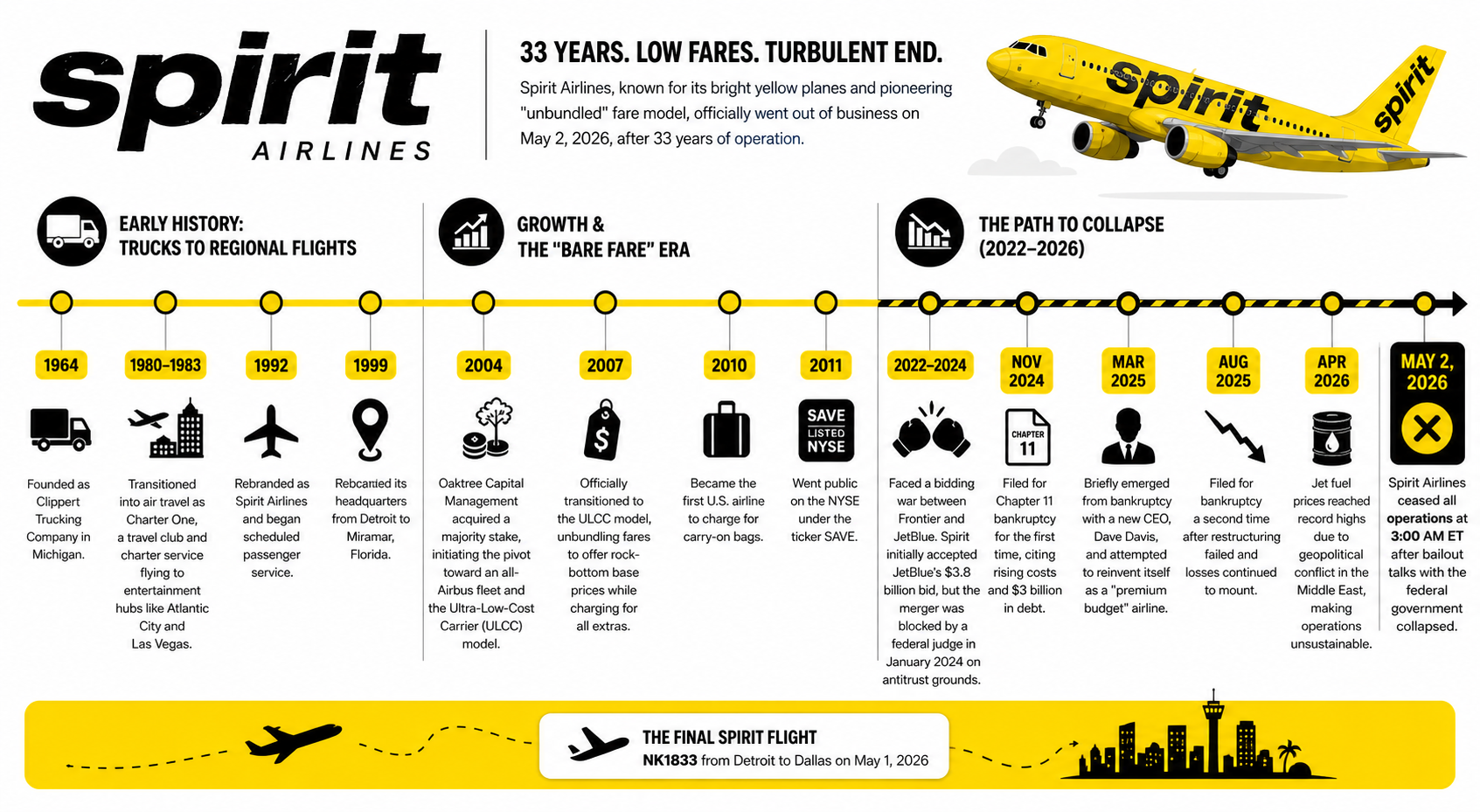
The sudden shutdown of Spirit Airlines has left thousands of passengers stranded and forced major U.S. airlines into a rapid response, offering capped fares and emergency travel options in an unfolding aviation shake-up.
After 34 years in operation, the budget carrier ceased all flights on May 2, 2026, following failed attempts to secure creditor backing and a government bailout aviation industry deal. The airline’s website now warns passengers not to head to airports, while refunds for card payments are being processed and other claims are tied up in airline bankruptcy proceedings.
Rescue Fares and Airfare Price Caps Take Center Stage
Rival airlines have moved quickly to fill the gap, rolling out temporary fare caps to absorb stranded passengers.
United Airlines is offering one-way fares capped at $199 for most routes and $299 for long-haul travel through mid-May. However, access requires passengers to join its frequent flyer programs (MileagePlus, A-List) and present proof of prior Spirit bookings.
Meanwhile, JetBlue Airways has introduced $99 rescue fares on select routes and capped other fares at $299, while adding 11 new routes to replace lost capacity.
Southwest Airlines is offering flat fares between $200 and $400 depending on distance, alongside status matching for former Spirit loyalty members, an aggressive move to win over displaced customers.
Industry Scramble Highlights Competitive Shifts
Legacy carriers are also stepping in. American Airlines has increased aircraft size on overlapping routes and is actively recruiting laid-off Spirit staff. Delta Air Lines has imposed short-term price caps on high-demand routes to stabilize passenger flow.
Budget rival Frontier Airlines is cutting base fares by 50%, though restrictions apply, including advance booking requirements and limited travel days.
These coordinated moves underscore a broader industry shift, as airlines compete not just for passengers but also for market share left behind by Spirit’s collapse.
Fallout From Pandemic and Fuel Costs
Spirit’s downfall reflects deeper structural pressures. The airline struggled to recover from the COVID-19 pandemic, while rising fuel costs, linked in part to geopolitical tensions, eroded its already thin margins.
Efforts to secure a bailout failed amid resistance from shareholders, who faced the prospect of heavy dilution under a taxpayer-backed rescue plan.
Travelers Face Uncertainty and Claims Process
For passengers, the shutdown means navigating refunds, rebooking, and potential travel insurance claims. While card payments are being refunded automatically, vouchers and loyalty points remain uncertain under bankruptcy proceedings.
The collapse also raises broader questions about the sustainability of ultra-low-cost travel, a model that once reshaped U.S. aviation by making flying accessible to millions.
Now, with Spirit gone, competitors are stepping in, but whether low fares will remain is far from certain.
Read also: $2.1bn in debt: Should taxpayers save Spirit Airlines?