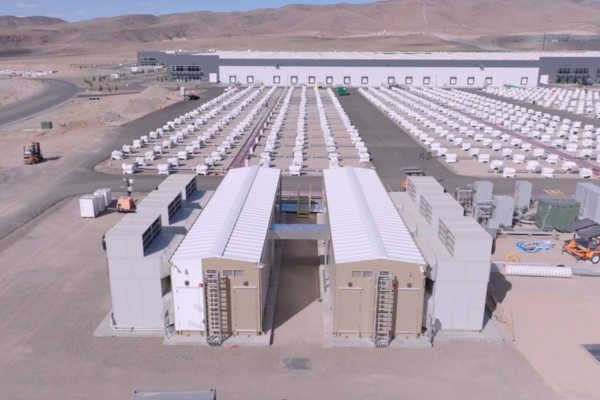
Used electric vehicle batteries could find a valuable second life powering AI data centres, helping meet growing electricity demand while reducing waste.
US battery recycling company Redwood Materials is expanding into energy storage systems that combine repurposed EV batteries, solar power and energy-management software. The technology could help data centres and industrial facilities access electricity while waiting for grid connections.
The development also offers a potential opportunity for Africa, where businesses face electricity supply challenges. If the technology proves safe and commercially viable, second-life batteries could support commercial buildings, charging stations and other facilities that need more reliable power.
Old batteries offer a new solution to growing electricity demand
US battery recycling company Redwood Materials is developing energy storage systems that could help power energy-hungry artificial intelligence (AI) data centres. The technology reuses electric vehicle batteries that are no longer suitable for cars but can still store electricity.
The systems combine second-life batteries, power electronics, control software and other energy sources, including solar power. They are designed to supply electricity directly to facilities that cannot secure enough power from the conventional grid.
The approach could help data centre operators avoid lengthy waits for grid connections, which can delay major infrastructure projects. It also offers a potential new source of value from used EV batteries, reducing waste while extending their useful life.
Redwood launched its Redwood Energy business in 2025, expanding beyond battery recycling and materials recovery into large-scale energy storage. The company aims to connect battery recovery, energy storage and power management within a single business model.
Rivian partnership demonstrates the technology
One of Redwood’s most significant projects involves electric vehicle manufacturer Rivian, which is using repurposed batteries to support its manufacturing operations in Illinois.
The companies announced an initial energy storage installation with a capacity of 10 megawatt-hours (MWh) at Rivian’s Normal factory. The system uses more than 100 second-life Rivian battery packs and is designed to provide stored electricity during periods of high demand.
In October 2026, the companies expanded their partnership to cover battery recycling, end-of-life packs and energy storage. Batteries collected through Rivian’s service network can be assessed for reuse before those unsuitable for a second life are sent for recycling.
The project illustrates how a battery can remain useful even after it loses some of the performance needed for driving. A pack with reduced capacity may no longer deliver the range an electric car owner expects, but it could still store electricity for a stationary installation.
AI boom increases pressure on electricity supplies
The rapid expansion of AI is increasing demand for data centres, which require substantial electricity to run computing equipment and cooling systems. Securing enough power has become a major challenge for companies building new facilities.
Redwood is targeting this problem with what the energy industry calls behind-the-meter systems. These installations generate or store electricity at the customer’s site, helping facilities meet some of their energy needs without relying entirely on the grid.
The company has also supplied a large battery system for a data centre operated by AI infrastructure company Crusoe. Redwood says its partnership with Crusoe has expanded computing capacity sevenfold, while the microgrid has achieved 99.2% uptime. These are company-reported figures, rather than independently verified industry-wide results.
Battery storage does not eliminate every power challenge. Data centres still need sufficient generation capacity, reliable energy management and suitable infrastructure to operate continuously. However, storage can help balance supply and demand, particularly when paired with solar generation or other energy sources.
Second-life batteries could create a circular economy
Redwood’s strategy highlights a growing opportunity to extend the useful life of electric vehicle batteries before recycling their materials. Instead of treating every used battery as waste, companies can assess whether it remains suitable for another application.
This approach could reduce the need to manufacture new batteries for every stationary storage project. It may also help recover more value from lithium, nickel, cobalt and copper when batteries eventually reach the end of their useful lives.
However, not every used battery is suitable for reuse. Operators must assess its condition, remaining capacity and safety before installing it in an energy storage system. Transport, testing, cooling, monitoring and installation costs will also affect whether second-life batteries are commercially competitive.
For Redwood, the opportunity is to build a business that connects battery recycling with the growing demand for reliable electricity. The model could create additional revenue while helping customers manage energy costs and make better use of existing resources.
What could this mean for Africa?
For African markets, second-life batteries could eventually support businesses that face unreliable electricity supplies or high costs associated with backup power.
Commercial buildings, factories, telecommunications infrastructure and electric vehicle charging stations are potential applications. When combined with solar power, battery storage can help businesses retain electricity generated during the day for use when sunlight is unavailable.
However, the economics will depend on local electricity tariffs, import costs, battery availability and the cost of alternative power sources. Appropriate testing, fire protection, maintenance and end-of-life recycling arrangements will also be essential.
Africa’s growing interest in electric mobility could eventually create a larger supply of used EV batteries for stationary storage. Developing the necessary testing, certification and recycling infrastructure will be important to ensure that these batteries are reused safely.
A new opportunity beyond electric cars
Redwood Materials’ expansion reflects a wider change in the energy industry. Batteries are becoming valuable not only for powering vehicles but also for supporting electricity networks and the digital infrastructure behind AI.
For data centre operators, the attraction is faster access to power. For automakers, it is an opportunity to recover additional value from batteries. For businesses and communities, it could provide another route towards more reliable electricity.
The commercial test will be whether second-life battery systems can deliver dependable power at a competitive cost. If they can, yesterday’s electric car batteries could become an important part of tomorrow’s energy infrastructure.
Read also: Mercedes-Benz electric vehicle sales surge 61% despite sharp China decline