When the Federal Government cut import tariffs on cars earlier this year, many Nigerians expected cheaper vehicles to follow. Months later, buyers in Lagos car markets are still waiting.
What the government changed
Under the 2026 Fiscal Policy Measures, contained in a circular dated 1 April, the government reduced the total effective tariff on fully built passenger vehicles, four-wheel-drive vehicles and station wagons from 70% to 40%, The Guardian reported. A further change took effect on 1 July, cutting the import levy on new vehicles from 20% to 10%, and on used vehicles from 15% to 5%.
The aim was to lower the cost of bringing vehicles into the country, improve supply and make cars more affordable.
More cars are arriving…
Data from the Nigerian Ports Authority (NPA) shows vehicle traffic through Nigerian ports rose 42.5% to 103,375 units in the first half of 2026, from 72,568 in the same period of 2025.
But that headline number needs context. According to the NPA, much of the growth came from transhipment at the PTML terminal at Tin Can Island Port, vehicles passing through Nigeria rather than all being sold in the domestic market.
…but prices haven’t fallen
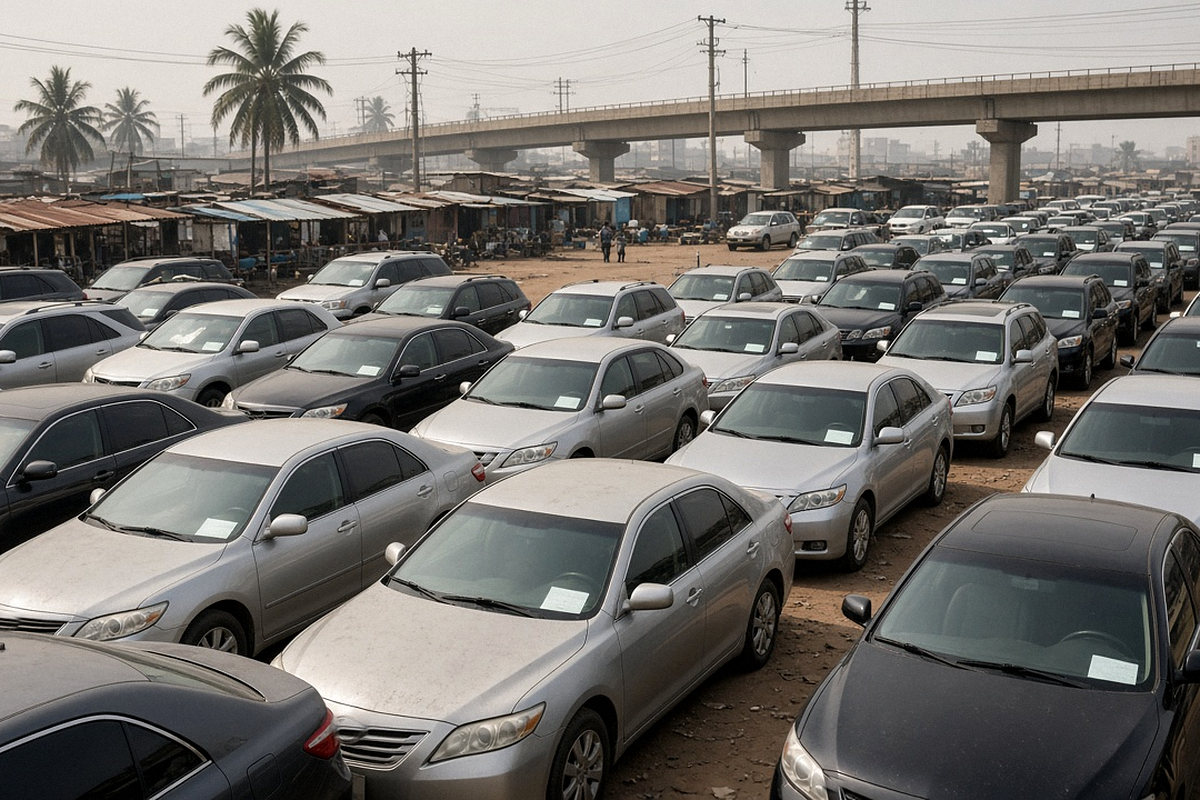
Market checks at Lagos car marts, including Berger, reported by Shipping Position Daily and carried by The Guardian, found some popular models have actually become more expensive:
| Model (foreign-used) | About 4 months earlier | Recent check |
|---|---|---|
| 2009 Toyota Corolla | ₦9.2m | ₦9.6m |
| 2015 Toyota Highlander XLE (3.5L V6) | ₦21m–₦22m | ₦23.5m |
Online listings showed some Corollas approaching ₦10m and 2015 Highlanders advertised between ₦22m and ₦25m, depending on condition and history.
Separate estimates published in November by Lagos-based car platform Carbin put clean tokunbo Toyota Corollas (2010–2014) at around ₦11m to ₦15m and Toyota Camrys (2012–2015) at around ₦15m to ₦21m, with good Nigerian-used versions typically 30% to 45% cheaper. These are a platform’s own estimates rather than official data, but they give buyers a useful reference point.
Why: “the exchange rate is still the same”
Dealers say the duty cut is only one piece of a much bigger cost puzzle. “We have not seen any impact. The prices of vehicles still remain the same because the exchange rate is still the same,” Theo Olaniran, General Secretary of the Car Dealers Association, told The Guardian.
The cost of a tokunbo car includes the price paid at auction abroad (in dollars), freight, insurance, port and terminal charges, customs clearance, transport, storage and the dealer’s operating costs. When most of those are tied to the dollar, a lower duty rate can be quickly cancelled out.
VehCAP: the next test for importers
Another policy in the background is the Vehicle Conformity Assessment Programme (VehCAP), launched on 31 March 2026 by the National Automotive Design and Development Council (NADDC) and the Standards Organisation of Nigeria (SON). It is designed to make vehicles and safety-critical parts pass inspection and certification before they are shipped to Nigeria, under the slogan “No Certification, No Entry.” AutoJournal Africa has also reported on related rules around wrecked and junk car imports.
Importers told Nairametrics in April that they did not expect VehCAP to significantly raise prices, since title documents are already part of normal imports. But enforcement has been slow: in April, reports said customs had not received operational directives. On 16 October, NADDC, SON and environmental regulator NESREA signed a reviewed memorandum of understanding to strengthen implementation. Public evidence of inspections and rejected vehicles at the ports is still limited.
Chinese brands are changing the new-car market
At the new-car end, Chinese brands are adding competition. Dr Femi Eguaikhide, Chairman of the LCCI Auto and Allied sector group, told ThisDay that the arrival of Chery, Jetour, GAC, Changan, Geely and BYD “has forced prices down”, saying a Nigerian “can now buy a brand new SUV for N28m instead of N55m”, while warning that most of these vehicles are imported fully built and local assemblers are running well below capacity.
What buyers should do now
- Compare tokunbo and Nigerian-used carefully. The price gap can be large, but so can the risk. Inspections of local used cars have already been rising, as AutoJournal Africa reported.
- Treat “too cheap” as a warning sign. Unusually low tokunbo prices can point to flood-damaged, salvage or misrepresented vehicles.
- Check history and documents. Ask for title documents and a vehicle history report before paying.
- Get a pre-purchase inspection from an independent mechanic.
- Consider new Chinese-brand models if your budget is in the ₦25m–₦35m range, but check parts and after-sales support in your city first.
Sources: The Guardian Nigeria (6 November 2026); Carbin tokunbo price index (16 November 2026); NADDC (31 March 2026); Nairametrics (13 April 2026); Independent Newspaper Nigeria (November 2026); ThisDay (14 November 2026).