
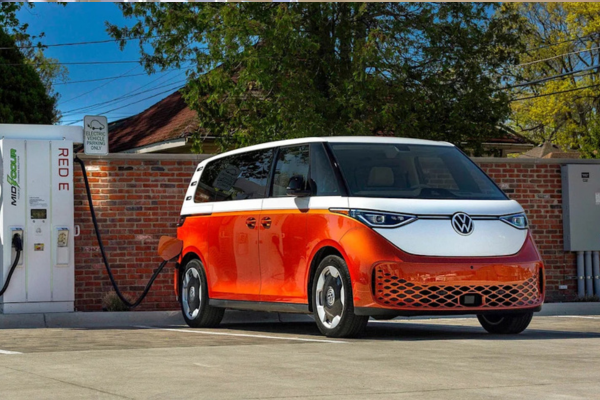
A Volkswagen ID.Buzz has completed an 8,222-mile journey across the United States, offering a strong real-world answer to one of electric motoring’s biggest fears: range anxiety.
The five-week trip covered 30 states and included 76 charging stops, according to the driver’s post on Reddit. The journey suggests that even electric vehicles with modest range can manage long-distance travel when supported by good planning and reliable charging access.
The ID.Buzz, nicknamed “Otto von Buzzmarck”, started north of Seattle before crossing major parts of the country. The route included Moab, Santa Fe, Atlanta, Boston, New York, Chicago, Minneapolis and Montana.
For many drivers, the Volkswagen ID.Buzz is not seen as a natural long-distance machine. Its estimated driving range of around 230 to 250 miles places it below some newer electric SUVs and premium EVs. But this trip challenges the idea that only long-range EVs can handle serious road journeys.
According to the driver, the van used 3,123 kilowatt-hours of electricity over the full route. That works out at about 2.62 miles per kilowatt-hour, a useful figure for a large electric van travelling across mixed terrain and climates.
The total charging cost was reported at $1,389. That means the trip cost about 16.9 cents per mile in electricity. The driver also estimated that the electric van saved between $700 and $800 compared with a petrol-powered Ford Transit returning 14 to 18 miles per gallon.
Charging delays were also limited, according to the post. The driver said they only had to wait once for a charger. The average charging stop lasted 23 minutes, and only two of the 76 charging sessions happened in remote locations without a backup charger nearby.
The figures matter because many potential EV buyers still worry about charging access, waiting times and real-world range. For family drivers, business users and road-trip enthusiasts, those concerns can delay the move from petrol or diesel vehicles to electric models.
This journey offers a more practical picture. It shows that range is important, but it is not the only factor. Route planning, charger availability, charging speed and driver habits can be just as important on long journeys.
The environmental comparison was also notable. The driver estimated that a similar petrol van would have produced about five tons of carbon emissions over the same journey. By comparison, the ID.Buzz was estimated to produce around one and a half tons, representing roughly a 70% reduction.
The driver also said the heavy use of DC fast charging did not appear to reduce the battery’s capacity during the trip. While one journey cannot settle wider battery-health debates, it adds another real-world example to the discussion around EV durability.
The trip also highlighted the importance of charging infrastructure. The driver praised the Ohio and Indiana Turnpikes, where charging stations are located in service areas. That kind of placement makes EV travel easier because drivers can charge where they already stop for food, restrooms and rest.
The driver also shared a useful tip for campers. Sites with 50-amp RV service can provide a full Level 2 overnight charge, sometimes at no extra cost, depending on the location and booking arrangement.
For Volkswagen, the story arrives at an important moment. The ID.Buzz is designed as a modern electric version of the classic VW Microbus, blending nostalgia with zero-emission driving. But buyers still want to know whether its lifestyle appeal can work in everyday long-distance use.
This 8,222-mile trip suggests that it can. The ID.Buzz may not offer the longest range in the EV market, but the journey shows that a well-planned route can make a modest-range electric van genuinely road-trip capable.
The wider lesson is simple. The future of EV adoption will not depend only on bigger batteries. It will also depend on better charging networks, smarter route-planning tools and public confidence built through real-world stories like this.
After 30 states, 76 charging sessions and more than 8,000 miles, the driver’s message was clear: electric vehicles with 230 to 250 miles of range should not be dismissed as unsuitable for long trips.
Read also: Volkswagen delays electric Golf as Xpeng eyes European production




![Your Car Spying on You [Tesla dashboard Fair&Smart]](https://autojournal.africa/wp-content/uploads/2025/01/Your-Car-Spying-on-You-Tesla-dashboard-FairSmart--350x250.png)