Chinese electric vehicles (EVs) are winning more European customers even as the European Union prepares tougher trade measures against their vehicles.
According to data from Gasgoo Automotive Institute, Chinese vehicle exports to Europe reached 438,400 units in the first quarter of 2026, an increase of 84.7% from a year earlier. The growth comes as Brussels considers extending anti-subsidy tariffs to Chinese-made plug-in hybrid vehicles.
The European Commission already imposed tariffs on Chinese electric vehicles in October 2024. Depending on the manufacturer, total duties can reach more than 45%.
Yet the measures have not slowed Chinese brands. By April 2026, Chinese automakers captured 9.8% of the European market, the highest level on record. Their share of the pure-electric vehicle market also exceeded 15% for the first time.
Anti-subsidy tariffs drive strategic shift
Chinese manufacturers quickly adapted after the EU targeted battery-electric vehicles.
Gasgoo data shows exports of plug-in hybrid vehicles surged 152.4% year-on-year to 106,000 units in Q1 2026, far outpacing growth in battery-electric vehicle exports.
The European Commission is now preparing to close that gap by extending tariff measures to hybrids.
Industry sources cited by Gasgoo said policymakers view the rapid rise of Chinese hybrid exports as a growing challenge to Europe’s domestic auto sector.
Industrial Accelerator Act (IAA) Raises Investment Requirements
The EU is also moving beyond tariffs. The proposed Industrial Accelerator Act (IAA) would introduce stricter rules for foreign investment in strategic industries, including electric vehicles and batteries.
The proposal includes requirements covering local staffing, research spending, technology transfers, and local sourcing.
Analysts say the measures are designed to encourage local production investment rather than vehicle imports.
Supply chain localisation becomes the new strategy
Rather than retreat, Chinese automakers are increasing their European presence.
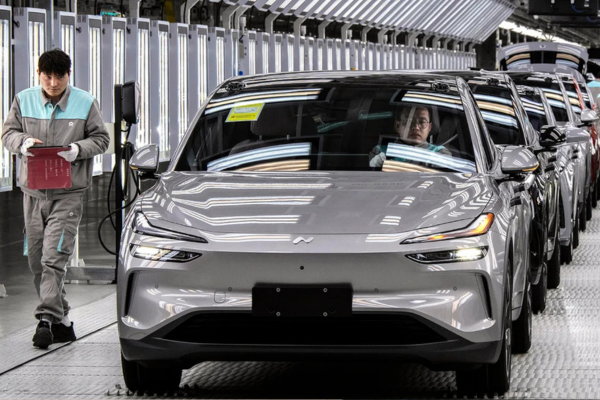
Chery, SAIC Motor, Leapmotor, Geely, Dongfeng, and XPENG are all pursuing factory partnerships, acquisitions, or production agreements across Europe.
Gasgoo estimates announced projects could eventually support more than 2 million vehicles in annual European production capacity.
Industry observers say rising tariffs are accelerating supply chain localization, transforming Chinese automakers from exporters into manufacturers operating inside Europe.
As Joyson Electronics Europe General Manager Wu Mei noted, building factories is only the first step. Long-term success will depend on earning trust from European customers, workers, and regulators.
Read also: Chinese carmakers targets Canada as launchpad for future US expansion