
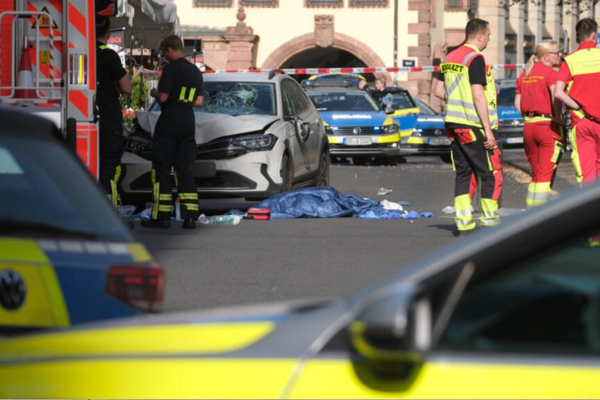
Two people were killed and at least 22 others injured after a car drove into a crowd in the German city of Leipzig on Monday, in what authorities described as a violent rampage.
The incident unfolded in the busy Grimmaische Straße shopping district, where pedestrians were struck in broad daylight, turning a routine afternoon into a scene of panic and emergency response.
Rising Concerns Over Urban Security Systems
Local officials confirmed that a 33-year-old German man had been arrested at the scene. Authorities said they were still investigating the motive, noting there was no immediate indication of political or religious intent.
Leipzig Mayor Burkhard Jung said the city was “utterly stunned” by the incident, describing it as a horrific act that left families mourning and many injured.
Police spokesperson Susanne Luebcke said the vehicle drove at high speed across Augustusplatz before entering Grimmaische Straße, striking multiple pedestrians along the way.
“This was a lone perpetrator, and we currently have no indication of further danger to the public,” she added.
Victims and Immediate Response
Authorities confirmed the victims included a 63-year-old woman and a 77-year-old man. Among the 22 injured, three remain in serious condition.
Eyewitness accounts painted a picture of chaos. One witness said she heard a loud bang before seeing people lying on the ground. Others described how bystanders rushed to provide first aid while attempting to stop the driver.
The vehicle eventually came to a halt after hitting bollards, which may have prevented further casualties—raising questions about the role of Public Safety Infrastructure in mitigating such attacks.
Mental Health Services Policy Under Scrutiny
Michael Kretschmer, head of the Saxony state government, said the suspect had a history of mental illness, adding another layer of complexity to the investigation.
Prosecutors have launched a murder and attempted murder case, but emphasized there was no evidence linking the attack to extremism.
The mention of mental illness has renewed debate over Mental Health Services Policy, particularly how individuals at risk are monitored and supported before incidents escalate into public harm.
Pattern of Attacks Raises Liability Insurance Claims Questions
Germany has experienced several similar incidents in recent years, including a deadly 2024 attack at a Christmas market in Magdeburg and another in Munich that left dozens injured.
Such repeated events are increasing pressure on city planners and insurers, particularly around Liability Insurance Claims tied to public space safety and event management.
Security experts note that the use of vehicles as weapons is becoming a persistent threat in urban environments, pushing demand for Surveillance Technology Solutions and reinforced pedestrian zones.
Future of City Design
The Leipzig incident adds urgency to discussions about how cities can protect public spaces without sacrificing openness. From bollards and restricted vehicle zones to advanced monitoring systems, experts say the future of urban safety will depend on how well cities adapt to evolving threats.
Read also: Road Accident Fund scandal: R43bn govt agency exposed for massive mismanagement


![Tesla [Reuters]](https://autojournal.africa/wp-content/uploads/2026/04/Tesla-Reuters-350x250.png)