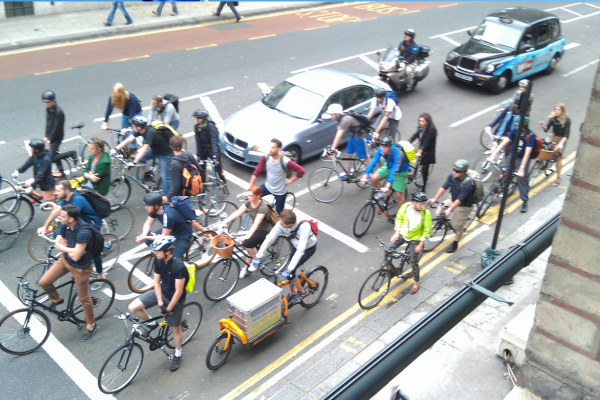
A growing online culture war between drivers and cyclists is reshaping how people experience city streets in London, raising new questions about transport policy regulation and the future of urban mobility infrastructure.
What was once a debate about road safety has become something more personal and more hostile.
Across London, motorists and cyclists are increasingly clashing not just on the roads, but online, where insults, surveillance footage, and activism collide. Drivers are branded “carbrains,” while cyclists face accusations of reckless rule-breaking. The result is a cycle of anger that experts say is being amplified by digital platforms.
Surveillance and Smart City Tensions
At the center of the conflict is the rise of citizen enforcement. Cyclists equipped with cameras are documenting road interactions and reporting violations.
One prominent figure has reported 2,491 drivers since 2019, highlighting how smart city surveillance systems are no longer just tools for governments but for individuals.
While some see this as a win for accountability, others argue it creates a culture of constant monitoring, increasing tension rather than trust.
Transport Policy Regulation Sparks Online War
Debates over cycle lanes, low-traffic neighbourhoods, and reduced speed limits have intensified divisions. Policies designed to improve safety are now flashpoints for broader cultural disputes. For many drivers, restrictions feel like an attack on personal freedom. For cyclists, resistance to these measures is seen as disregard for safety.
These opposing views are often amplified online, where anonymous accounts and advocacy groups escalate discussions into aggressive exchanges.
Road Safety Liability Law and Rising Friction
The conflict has implications beyond social media. Legal and financial systems are increasingly affected, particularly in areas like road safety liability law and automotive insurance claims.
Video evidence captured by cyclists is now being used in reporting incidents, potentially influencing liability decisions. This shift could reshape how accidents are documented and resolved.
However, critics warn that selective footage and online outrage may distort reality, complicating fair assessments.
A Culture of Division, Not Dialogue
Observers suggest that the real issue is not transport itself, but the breakdown of civil discourse.
Many participants in these online battles are not necessarily advocating for policy change, but engaging in what some describe as “performative outrage.” The goal, critics argue, is not resolution but reaction.
This dynamic mirrors broader global trends, where digital platforms reward conflict over consensus.
A Different Model for Coexistence
Some point to examples outside the UK for a different approach. In parts of southern Europe, busy streets see cars, bikes, and pedestrians sharing space with less visible conflict.
The difference, analysts say, lies in social interaction. Face-to-face engagement reduces anonymity—and hostility.
The Road Ahead
As cities invest in urban mobility infrastructure, balancing safety, efficiency, and social cohesion will remain a challenge. The question is no longer just how people move but how they coexist.
Read also: UK ‘car cannibals’ stripped 98 vehicles in two-year spree