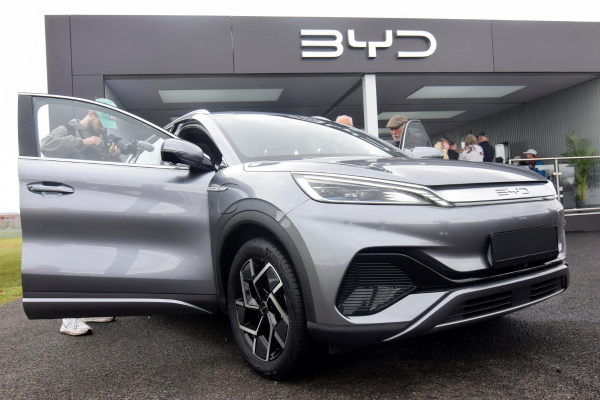
European carmakers face a growing challenge from Chinese rivals as a record 20 Chinese brands prepare to exhibit at next week’s Paris Motor Show, highlighting China’s rising influence in Europe’s electric vehicle market.
The number of Chinese brands attending the show has doubled from the 2024 event. Established manufacturers BYD and Chery will be joined by newer names, including Aito and Avatr, as Chinese automakers expand their push into Europe.
The show comes as European manufacturers face weak demand, rising costs and pressure to develop more affordable electric vehicles (EVs). They are preparing new models to defend their home market as Chinese brands gain ground with electric cars and plug-in hybrids.
“The Chinese are saying ‘we’ve got to try and dominate Europe because we can’t do anything in the US’,” said Brad Kunz, a partner at consultancy Grant Thornton Stax.
“If the US had allowed Chinese automakers in, Europe … wouldn’t be so much of a battleground.”
Chinese car brands gain market share in Europe
Chinese brands held 10.7% of the European car market in the second quarter of 2026, up from 5.7% a year earlier, according to Schmidt Automotive Research data cited by Reuters.
Their growth is also visible in plug-in hybrid vehicles, which combine a rechargeable battery with another power source.
Chinese brands accounted for more than 26% of Western Europe’s plug-in hybrid market in the second quarter, compared with just 2.2% in the same period two years earlier.
The shift comes as sales by European manufacturers in China have fallen since the COVID-19 pandemic. Chinese automakers, facing limited access to the United States and weaker demand at home, have increasingly turned to Europe.
The European Union imposed tariffs on Chinese-made fully electric cars two years ago. Chinese manufacturers have responded by expanding into combustion-engine vehicles and plug-in hybrids.
European carmakers are now pushing for tariffs on Chinese plug-in hybrids. The EU is also working on legislation that would require minimum levels of local content for electric vehicles to qualify for certain subsidies or government contracts.
Volkswagen and BMW face cost pressure
Competition from China is adding to the challenges facing European automakers, which are also dealing with weak demand, US tariffs and the cost of electrification.
Volkswagen is cutting thousands of jobs and considering factory closures to reduce costs. Luxury carmaker BMW is also shedding thousands of workers.
At the same time, European manufacturers are seeking ways to benefit from Chinese investment and technology.
Stellantis, for example, has partnered with China’s state-owned Dongfeng. European carmakers are also looking to sell capacity at underused factories and gain access to electric vehicle technology.
“The Europeans are playing a sort of double game,” said Pedro Pacheco, vice president of research at Gartner.
Affordable electric cars become a priority
European manufacturers are preparing a new generation of more affordable electric cars to compete with Chinese models.
“This motor show will probably be the most important one in the region since the pandemic,” said automotive analyst Felipe Munoz.
“This is the platform the Europeans are using to tell the Chinese they’re still strong and still ready.”
One major European launch will be Stellantis’ revival of the Citroen 2CV. The model will test rules that allow carmakers to remove some features to make electric vehicles more affordable.
Chinese brands are also seeking to build their presence beyond their home market.
Aito, the premium brand owned by Chongqing-based Seres Group, plans to launch four premium electric SUVs for Europe at the Paris show. It aims to raise overseas sales to 20% of total volumes within three years, from less than 1% currently.
Francois Roudier, secretary-general of the International Organisation of Motor Vehicle Manufacturers, said the arrival of Chinese brands had helped revive motor shows after some traditional manufacturers reduced their participation.
“For years people were buying cars, now manufacturers have to sell them,” he said, adding that manufacturers who did not attend “have made a mistake”.
“It’s no show, no sell in a way.”
The record turnout reflects a market in which manufacturers on both sides must work harder to attract buyers as competition intensifies.
Read also: Chinese car brands close the gap as Germany’s new-car market grows