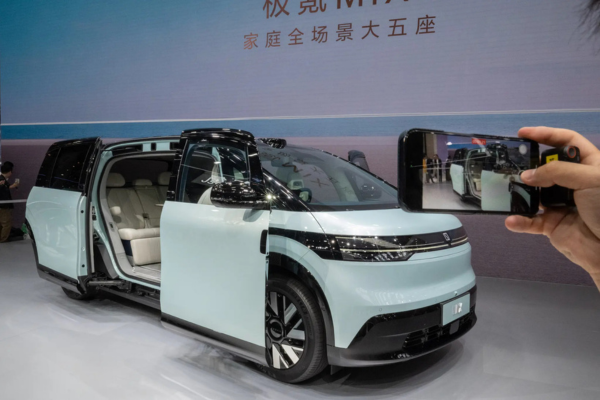
Germany’s new-car market is growing, but the biggest change is happening beneath the headline figures. New registrations reached 2.22 million vehicles between January and September 2026, up 5.3% from the same period last year.
The figures show that established manufacturers are facing stronger competition, particularly from rapidly expanding Chinese brands.
Chinese manufacturers recorded 148,102 registrations, an increase of 62.3% year-on-year. Their combined market share rose from 4.3% to 6.7%.
That puts Chinese carmakers almost level with Japanese manufacturers, whose registrations fell by 8.6% to 148,403 vehicles. The figures come from Germany’s Federal Motor Transport Authority (KBA), with analysis from the Center of Automotive Management (CAM).
Volkswagen remains dominant, but its lead is narrowing
The Volkswagen Group remains Germany’s largest automotive group, accounting for almost two-fifths of the market. It recorded 876,797 registrations during the first nine months of 2026. However, this represented a 0.4% decline compared with the same period last year.
Its market share fell from 41.7% to 39.5%. The performance within the group was mixed. Škoda registrations increased by 12.8%, while Audi grew by 4.8%. The Volkswagen brand itself, however, recorded a 5.7% decline.
The figures underline the growing pressure on Volkswagen in its home market as customers gain more choices, particularly in electric vehicles.
Stellantis strengthens its position
Stellantis was among the major established groups to make progress. The company recorded 257,835 registrations, an increase of 7.4% year-on-year. Its market share also increased from 11.4% to 11.6%.
Fiat was a major contributor, with registrations rising by 22.1%. Opel also recorded growth, with registrations increasing by 6.1%. The results suggest Stellantis is managing to capture part of the additional demand in Germany while defending its position against both German and Asian competitors.
BMW continues to outperform Mercedes-Benz
The German premium-car battle also shifted further in BMW’s favour.
BMW Group registrations increased by 7.4% to 222,346 vehicles, taking its market share to 10%. Mercedes-Benz, meanwhile, recorded more modest growth of 2%. Its market share declined from 9.1% to 8.8%.
The difference highlights the contrasting performances of Germany’s two major premium manufacturers at a time when the industry is investing heavily in electric vehicles, software and new vehicle platforms.
Chinese brands are becoming a serious force
The most striking figures come from Chinese manufacturers.
Their combined registrations jumped by 62.3%, reaching 148,102 vehicles in the first nine months of 2026.
Their market share increased by 2.4 percentage points, from 4.3% to 6.7%. BYD has been one of the biggest drivers of this expansion. Its German registrations increased by more than 262%.
The rapid growth suggests Chinese manufacturers are moving beyond being niche players in Europe’s largest car market. They are increasingly competing directly with established manufacturers on price, electric vehicle technology, equipment and product choice.
US brands also make gains
US manufacturers also recorded strong growth. Registrations increased by 22% to 119,656 vehicles, lifting their market share from 4.6% to 5.4%. Tesla was the main source of that growth, with registrations increasing by more than 200%.
Ford, however, moved in the opposite direction and recorded a decline.
Germany’s electric-car transition adds another layer
The wider market is also undergoing a major technological transformation. Battery-electric vehicles accounted for 34.5% of new registrations, according to the figures provided. That means more than one in every three new vehicles registered during the period was fully electric.
The growing importance of EVs could further reshape the competitive landscape because Chinese manufacturers have invested heavily in electric drivetrains, batteries and related technologies.
For German manufacturers, the challenge is therefore no longer simply about protecting their traditional market share. They must also compete on electric vehicle pricing, battery technology, software, production costs and speed of innovation.
A new competitive era for Germany
The German market is entering a more competitive phase. Volkswagen remains overwhelmingly important, but its declining share shows that size alone may not guarantee future dominance.
At the same time, Chinese manufacturers are expanding rapidly and converting that growth into meaningful market share.
The next few years could therefore prove crucial for Germany’s automotive industry.
The companies that can combine competitive pricing, strong electric vehicles, advanced software and efficient production are likely to be best positioned for the next stage of the industry’s transformation.
Source: KBA | Analysis: Center of Automotive Management (CAM)
Read also: Volkswagen shareholder urges China-made models to be built in Germany as job fears rise


![Toyota sales [Source Reuters]](https://autojournal.africa/wp-content/uploads/2024/09/Toyota-sales-Source-Reuters-350x250.png)