Chinese automakers are expanding their push into South Africa, bringing new electric vehicles, hybrid SUVs and pickup trucks to a market where buyers are demanding more choice and affordable technology.
At the WesBank Festival of Motoring in Johannesburg, several Chinese brands unveiled new models as they seek a bigger share of the South African automotive market.
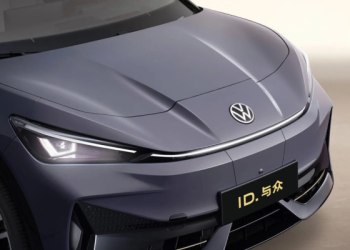
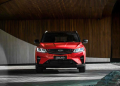
Changan and Jameel Motors South Africa introduced the Deepal S05 range-extended electric vehicle, which uses a small petrol engine to recharge its battery while driving. Changan also introduced the Uni-S hybrid SUV.
Dongfeng distributor E Auto Motor launched the Forthing Friday range-extended crossover and Friday battery-electric vehicle. It also introduced Chinese brand Kaiyi.
Chinese EV Brands Expand in South Africa
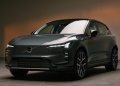
BAIC introduced its premium new-energy vehicle brand ARCFOX, starting with the T1 compact electric SUV, which is expected to launch in October.
The companies are targeting both price-sensitive and affluent buyers as electric vehicle adoption grows in South Africa.
WesBank CEO Robert Gwerengwe said Chinese vehicles had already made a major impact on vehicles financed by the bank.
“Last month, on the new vehicles we financed, about 40% of them were Chinese vehicles,” Gwerengwe told journalists.
He said this compared with 0.01% in 2016.
The figures underline the rapid growth of Chinese automakers in the market, even though electric vehicles still account for a small share of overall sales.
Chinese Automakers Challenge the Pickup Market
Chinese brands are also moving deeper into South Africa’s pickup truck market, traditionally dominated by Toyota, Ford and Isuzu.
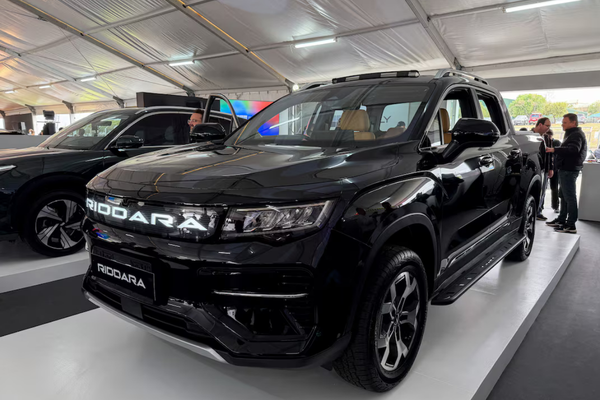
LDV and Jiangling Motors expanded their pickup ranges with conventional fuel models, while Geely entered the market through its all-electric Riddara pickup. Chery also entered the segment.
Dongfeng is planning a wider local portfolio. Its South Africa National Sales Manager JP Geldenhuys said E Auto Motor aims to have about 14 vehicle models in the country by the first quarter of 2027, compared with three currently.
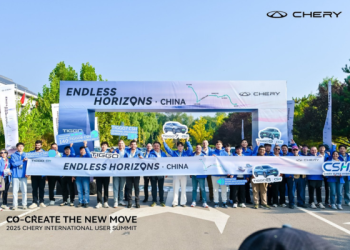
Chery-owned LEPAS also plans to expand into battery-electric and plug-in hybrid vehicles.
“The future is new energy vehicles,” said Jay Jay Botes, general manager of LEPAS & Chery South Africa. He said the company wants to take a large share of the market.
Meanwhile, Chery-owned Omoda & Jaecoo is targeting a 60% internal-combustion-engine and 40% new-energy-vehicle mix by the end of 2027, compared with 81% and 19% currently.
BAIC said it would expand its new-energy vehicle offering beyond the ARCFOX T1 and plans future entries into the pickup market.
Read also: Fuel crisis pushes drivers into plug-in hybrids across South Africa