
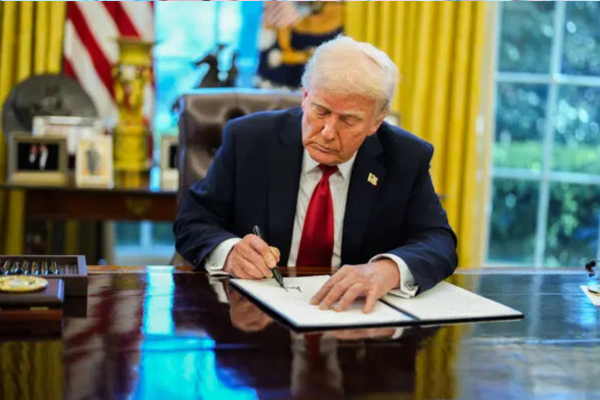
President Donald Trump has threatened a 50% tariff on cars, trucks and automotive parts from Canada from January 1, 2027, raising the risk of higher costs for automakers and consumers and putting pressure on one of North America’s most connected supply chains.
Trump’s warning came after U.S.-Canada trade talks broke down last week. A proposed deal would have reduced the tariff on Canadian cars and light trucks from 25% to 15%. It would also have cut steel and aluminum tariffs from 50% to 25%.
The proposed deal collapsed on Friday.
The threat has raised concerns across the automotive industry because U.S. vehicle production depends heavily on parts and vehicles made in Canada.
Flavio Volpe, president of Canada’s Automotive Parts Manufacturers’ Association, said the cost would ultimately reach U.S. factories.
“A threatened U.S. tariff on Canadian auto parts will be paid by (the) US auto assembly,” Volpe said. “Without those specific parts, auto assembly throughout the U.S. would halt.”
Trump said companies that build in the United States would face zero tariffs. “Build in the U.S. and there are ZERO TARIFFS,” Trump wrote in a social media post.
U.S. Treasury Secretary Scott Bessent said Trump wants Canada to return to the negotiating table.
Canadian Prime Minister Mark Carney said a deal was still possible, but said the United States must respect Canada’s sovereignty.
The threat quickly affected auto stocks. Ford shares fell 3.6%, while Stellantis shares dropped 4.2%. General Motors shares declined 1.6%. Toyota shares were down 1.5% in New York trading, while Honda shares fell 2.1%.
The broader trade relationship is also significant. U.S. goods and services trade with Canada totaled $872.3 billion last year, down 4.6%.
Canada exported about three-quarters of its goods to the United States and imported almost half of its goods from the U.S.
Canada has also announced retaliatory tariffs on some U.S. goods starting September 8.
The trade fight could therefore create pressure across manufacturing, supply chains, investment and consumer markets if the threatened tariffs take effect.
Read also: Will Brexit EV tariffs break the EU-UK auto industry?













![Gordon Murray S1 LM supercar [Source: Auto Evolution]](https://autojournal.africa/wp-content/uploads/2025/11/Gordon-Murray-Auto-Evolution-120x86.png)