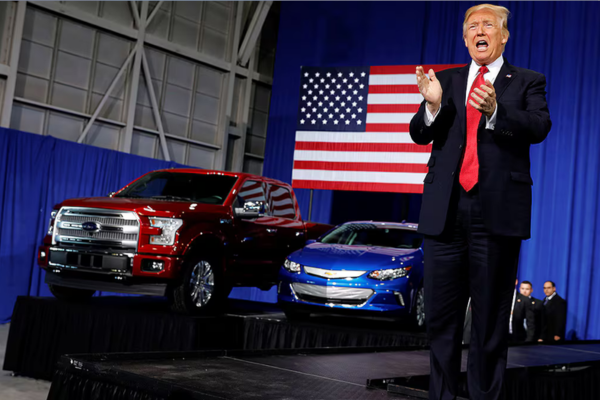
President Donald Trump is heading to Detroit this week, shining a spotlight on the U.S. manufacturing sector amid a troubling decline in factory jobs. His visit, which includes a speech at the Detroit Economic Club and a tour of Ford’s (F.N) production center in Dearborn, comes as nationwide factory employment fell by 8,000 in December, below levels seen in much of his first term.
A Struggling Manufacturing Sector
The visit coincides with the Detroit Auto Show, where the Big Three automakers; Ford, General Motors (GM.N) and Stellantis (STLAM.MI), are showcasing new models and technological innovations. Yet the backdrop remains concerning. Auto executives spent much of 2025 adjusting to fluctuating tariffs, which disrupted supply chains and cost billions, while rare-earth magnet restrictions from China complicated vehicle production.
Trump has argued that new plants opening “at levels that nobody has ever seen” are a direct result of his tariff policies. Analysts, however, point to a lack of evidence for a true construction boom. “Even if it’s not linked to law, it still influences the discussion,” said Norman Bishara, a University of Michigan business ethics professor, noting companies may act preemptively to stay in the administration’s favor.
Economic Signals and Political Stakes
Trump’s visit also underscores broader affordability concerns. Approval on cost-of-living issues remains low at 27%, according to a Reuters/Ipsos poll. While mortgage rates have dipped under 6% for the first time since March 2023, and gasoline averages $2.81 per gallon—the lowest since March 2021—many voters still feel the pinch.
In Michigan, a key battleground state ahead of the 2026 midterms, the president faces high stakes. An open Senate seat and several competitive House races mean that economic messaging may overshadow prior foreign policy theatrics.
Trade, Tariffs, and U.S.-Canada-Mexico Relations
Sandy Baruah, CEO of the Detroit Regional Chamber, urged Trump to provide clarity on trade with Mexico and Canada after prior disruptions to the USMCA trade pact. Auto executives are watching closely, hoping for stability that can support long-term investment decisions.
Trump is also spotlighting recent consumer wins, including a $200 billion mortgage bond purchase and encouraging oil companies to boost Venezuelan crude output to ease fuel prices globally. Whether these moves translate into sustained economic recovery or short-term political optics remains uncertain.
Read also: Detroit big three face rising competition in 2025 US auto sales
![petrol cars [GB News]](https://autojournal.africa/wp-content/uploads/2026/04/petrol-cars-GB-News-350x250.png)