
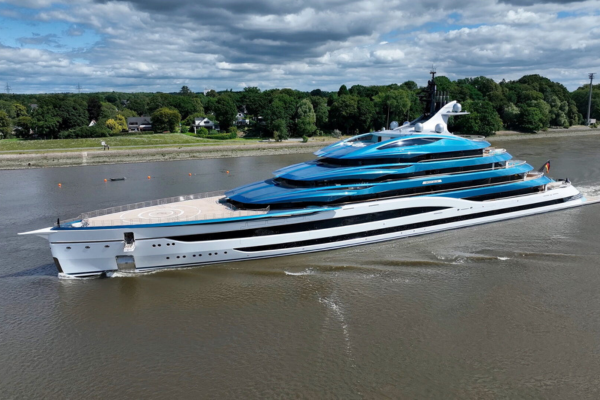
As 2025 ends, the world’s largest yacht builders delivered some of the biggest and most advanced superyachts ever built, highlighting continued demand for scale, luxury and cleaner marine technology.
Shipyards in Germany, the Netherlands, Italy and Turkey launched or delivered more than 20 yachts measuring between 74 metres and 134 metres this year, according to industry data compiled by SuperYacht Times. Several projects introduced hybrid-electric, diesel-electric and hydrogen fuel-cell systems, reflecting growing pressure on the luxury maritime sector to cut emissions.
The largest yacht of the year was Alnanha, a 134.2-metre vessel built by German shipyard Lürssen. Launched in June and seen on sea trials in August, the yacht features a metallic-blue superstructure and tiered decks designed by Winch Design. Naval architecture was developed by Lürssen Yachts.
At 120 metres, Tanzanite became the largest yacht ever built by Amels. The five-deck vessel, designed by Espen Øino, offers more than 6,000 gross tonnes of interior space and can host 22 guests and 44 crew. Construction began in 2020, and sea trials started in the Netherlands in October.
Innovation was most visible in the Netherlands, where Feadship delivered Breakthrough, a 118.8-metre yacht powered by hydrogen fuel cells. At 7,247 gross tonnes, it is the largest yacht ever built in the country by interior volume. Designed by RWD with naval architecture by De Voogt Naval Architects, Breakthrough can host 30 guests and 43 crew. It was sold in September and is now available for charter.
Feadship also delivered several other large yachts, including Moonrise at 100.7 metres, Pi at 100 metres, and Valor, a 79.5-metre hybrid yacht combining diesel-electric, solar and battery systems. Another Feadship delivery, Faith, uses an advanced electrical drive system with more than four times the battery storage of the yard’s first hybrid yacht.
German builder Lürssen dominated the top end of the market. Alongside Alnanha, it launched Boardwalk at 117 metres in December, Project Cosmos at 114.2 metres and Icecap at 110 metres. Project Cosmos marked Lürssen’s first fuel-cell-powered superyacht and was launched during the yard’s 150th anniversary year.
“These projects show how owners still want size, but now also want efficiency and future-ready systems,” said a European yacht broker involved in several 2025 deliveries, who declined to be named due to client confidentiality.
Dutch builder Oceanco delivered two 111-metre yachts in November. Leviathan, owned by Valve co-founder Gabe Newell, uses a hybrid-electric system and focuses on crew wellbeing, featuring large communal spaces, a gaming lounge and sports facilities. DreAMBoat, commissioned by a returning client, ranks among the largest yachts Oceanco has built by volume.
Beyond the 100-metre range, builders continued to deliver highly customised vessels between 75 and 80 metres. These included Al Reem from Bilgin Yachts, Pangea from Amels, Nympheas from Turquoise Yachts, and Odisea, a 78-metre Lürssen launch.
While the yachts remain symbols of extreme wealth, industry executives say cleaner propulsion systems are becoming standard rather than optional.
Hybrid, battery and fuel-cell technologies are no longer experimental at this level, they are now part of how owners define value.”
Despite rising construction costs and tighter environmental rules, demand for large yachts has remained resilient. Several vessels launched in 2025 are already sold, chartered or scheduled for delivery in 2026.
As shipyards look ahead, the challenge will be balancing scale, sustainability and public scrutiny in an industry that increasingly sits at the crossroads of innovation and excess.
Read more on Royal Huisman unveils sky, set to become the world’s tallest sailing yacht by 2030