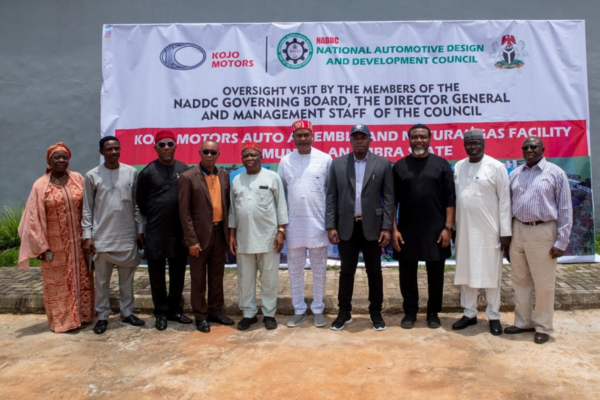
The Governing Board of the National Automotive Design and Development Council (NADDC), led by its Chairman, Chief Emma Eneukwu, on Wednesday, September 16, 2026 paid an oversight visit to the nearly xompleted multi-billion naira Kojo Motors Assembly Plant located at Umunya, along the Enugu-Onitsha Expressway in Anambra State. The visitation is in furtherance of federal government’s efforts to strengthen local vehicle production and deepen Nigeria’s automotive manufacturing capacity.
Accompanied by the Director-General of NADDC, Otunba Oluwemimo Joseph Osanipin, and senior officials of the Council, the board inspected the assembly facility and received presentations on Kojo Motors’ investment in vehicle assembly, alternative-fuel mobility and the development of indigenous automotive manufacturing capacity.
The auto assembly facility is one of the investments that has emerged from the growing push for local vehicle assembly in Nigeria.
Chinedu Oguegbu, Managing Director of OMAA briefly gave an graphic illustration of the multiple-billion Kojo Motors automotive assembly facility which had already started with Semi Knocked Down capacity and later to complete knocked down facility.
He said that also in the strategic development plan is the setting up of massive liquified petroleum gas (LPG) and compressed natural gas-powered station for for Yutong and OMAA passenger and commercial vehicles and other facilities supporting cleaner-energy mobility.
The LPG/CNG facility will also serve as a regional station to provide service all the other neighbouring states near Anambra State.
Chinedu Oguebgu added that, the one of the local components addition to the vehicle is are the seats. He disclosed the company has a seat manufacturing facility, adding that it can also produce quality seats of any size, dimensions and configuration for other local auto assemblers that meets global standards.
The NADDC Board members were taken through various sections of the facility and briefed on the company’s assembly operations, production plans, technology partnerships and efforts to contribute to the development of Nigeria’s automotive value chain.
lt also provided an opportunity for the team to assess the challenges confronting indigenous assemblers and identify areas where government policy, technical support and institutional collaboration could further facilitate investment and production.
Speaking during the tour, the Chairman of the NADDC Governing Board, Chief Emma Eneukwu, commended Kojo Motors for committing substantial resources to automotive manufacturing and urged other indigenous investors to take advantage of opportunities in the sector.
“What we have seen here at Kojo Motors demonstrates that Nigerian investors can build viable automotive manufacturing capacity when there is commitment, vision and the right policy environment. The responsibility before NADDC is to continue creating an enabling environment in which investments such as this can grow, deepen local content and create jobs for Nigerians”.
Eneukwu said the Board would continue to support initiatives capable of advancing the objectives of the Nigerian Automotive Industry Development Plan (NAIDP), particularly in the areas of local manufacturing, technology transfer, skills development and greater participation of Nigerian companies in the automotive value chain.
Also speaking, the NADDC Director-General, Otunba Oluwemimo Joseph Osanipin, said the visit was part of the Council’s continuing engagement with automotive assemblers to understand their operational realities and develop practical interventions that would increase production and local content.
“Our objective is not simply to have more assembly plants in Nigeria; we want to see increased production, stronger local content, technology transfer and a value chain that creates sustainable employment and industrial opportunities. Facilities such as Kojo Motors are important to this vision, and NADDC will continue to work with investors and other stakeholders to address the challenges affecting automotive production”.
Osanipin has previously stressed the importance of linking vehicle assemblers with local component manufacturers so that Nigerian-made parts can meet the quality and technical specifications required by assembly plants.
NADDC has also stated that increasing local content is a central component of the country’s automotive development strategy.
In his welcome address, Chairman of Kojo Motors Limited, Ikenna Oguegbu, expressed appreciation to the NADDC Board for visiting the facility, describing the engagement as significant to the company’s efforts to expand local automotive manufacturing.
“We are delighted to welcome the NADDC Governing Board to Kojo Motors. This visit is a strong encouragement to indigenous investors who have committed their resources to building Nigeria’s automotive industry. We remain committed to working with NADDC and other stakeholders to make this facility a centre of automotive production, technology transfer, employment and value creation”.
While re-iterating that Kojo Motors remained committed to contributing to the development of a sustainable automotive ecosystem in Nigeria through local assembly, cleaner-energy transportation solutions, skills development and collaboration with international technology partners, he called for support from the federal government, adding that it’s impact on employment generation to Nigerians and other spin-off businesses within the locality will be enormous.
The NADDC Board’s visit comes against the background of the Federal Government’s renewed emphasis on expanding local vehicle production and strengthening the domestic automotive value chain. The Council’s current development framework includes increasing vehicle production, transitioning toward deeper manufacturing, raising local content and expanding electric-vehicle production.
lt provided a platform for government and industry to examine how indigenous assembly investments can be supported to move beyond vehicle assembly into deeper manufacturing, component sourcing, technology development and sustainable mobility.
With the Umunya facility strategically located along the Enugu-Onitsha Expressway, the investment is also positioned to contribute to the industrial development of the South-East and Nigeria’s broader automotive manufacturing ambitions.