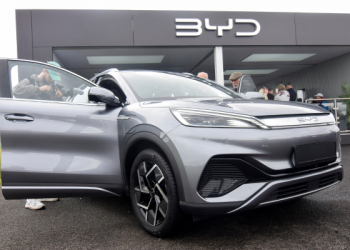
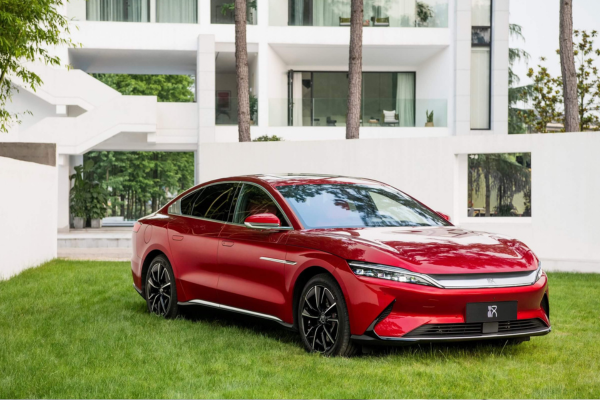
BYD’s next flagship electric sedan appears to be moving closer to launch, as China’s electric vehicle market enters a new phase of long-range, ultra-fast charging cars.
The new model, known as the BYD Great Han, has been seen testing on public roads in China. The sighting suggests that the car could be revealed within months, with reports pointing to pre-sales in August and a market launch in September.
For everyday drivers, the promise is simple but powerful: less waiting, longer journeys and a charging experience that feels closer to filling a petrol tank.
The Great Han is expected to sit alongside BYD’s Great Tang, a full-size electric SUV already linked to the company’s latest battery and charging technology. The sedan is likely to become the lower, sleeker companion to that SUV, aimed at buyers who want flagship performance in a more traditional executive car shape.
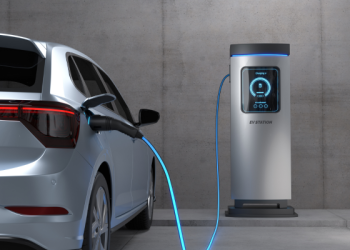
At the centre of the story is BYD’s new Blade Battery 2.0 and Flash Charging platform. BYD says the system can support charging power of up to 1,500kW, allowing compatible vehicles to charge from 10% to 97% in about nine minutes under ideal conditions.
Some reports say the system can take a battery from 10% to 70% in around five minutes. That is the figure likely to attract the most attention, because charging time remains one of the biggest concerns for people considering an electric vehicle.
The Great Han is also expected to offer up to 1,000km, or about 621 miles, of driving range on China’s CLTC test cycle. Real-world range will depend on speed, weather, tyres, driving style and road conditions, but the headline figure still places the car among the most ambitious electric sedans in development.
Reuters reported in March that BYD’s second-generation Blade Battery can deliver a driving range of 777km, while higher-end models from BYD’s premium brands could exceed 1,000km. This shows that BYD is using the technology across different price levels, from mainstream models to luxury vehicles.
The business case is also strong. BYD is already one of the world’s most aggressive electric car manufacturers, and China remains the toughest EV market on the planet. Brands are fighting on price, technology, range and charging speed.
That pressure is forcing innovation at a pace many Western carmakers are struggling to match. For buyers, it means better cars, faster charging and more choice. For rivals, it raises the standard again.
The Great Han could also arrive at a slightly lower price than the Great Tang SUV. The Great Tang has been reported with pre-sale prices starting around 250,000 yuan, equal to roughly $36,500.
If BYD can bring similar charging speed and range to a sedan at a more accessible price, the Great Han could become one of the most closely watched EV launches of 2026.
The company is also investing heavily in charging infrastructure. BYD said it aims to build 20,000 Flash Charging stations in China by the end of 2026, including thousands along highways.
That matters because fast-charging technology only becomes useful when drivers can access the right chargers. A five-minute charging claim is impressive, but it depends on compatible vehicles, compatible charging stations and strong grid support.
Still, the direction is clear. BYD wants to remove the biggest emotional barriers to EV adoption: fear of running out of charge, long waiting times and uncertainty on long-distance journeys.
For many drivers, electric cars already offer lower running costs and reduced routine maintenance compared with petrol and diesel vehicles. They have fewer moving parts, need no oil changes and produce no tailpipe emissions.
The Great Han could take that advantage further by making EV ownership feel more convenient, especially for families, business users and long-distance drivers.
BYD has not yet released full official specifications for the Great Han. Until it does, the reported range, charging speed and launch dates should be treated as early information rather than final confirmation.
But if the figures hold, the Great Han will not just be another electric sedan. It could become a clear signal that the next battle in the EV market will be fought on charging speed, real-world convenience and value.
Read also: BYD’s global EV surge puts Tesla under fresh pressure