• News
    • Tech
    • Lifestyle
    • Business
    • Opinion
    • Premium
  • Reviews
  • Events
    • Nigeria
    • South Africa
  • Tools
    • Price Guide
    • Find your idea car
    • Car valuation
    • Sell your car
    • Car insurance quote
    • Locate a dealer
    • Deals
  • For Sale
    • New Cars for sale
    • Cheap Cars for sale
    • Bikes for sale
    • Trucks for sale
    • Boats for sale
    • Jets for sale in Africa
    • Cars under 5m
    • EV in Nigeria
    • EV in South Africa
Thursday, June 11, 2026
  • Login
Auto Journal Africa
  • News
    • Tech
    • Lifestyle
    • Business
    • Opinion
    • Premium
  • Reviews
  • Events
    • Nigeria
    • South Africa
  • Tools
    • Price Guide
    • Find your idea car
    • Car valuation
    • Sell your car
    • Car insurance quote
    • Locate a dealer
    • Deals
  • For Sale
    • New Cars for sale
    • Cheap Cars for sale
    • Bikes for sale
    • Trucks for sale
    • Boats for sale
    • Jets for sale in Africa
    • Cars under 5m
    • EV in Nigeria
    • EV in South Africa
Ask Autojorunal AI
No Result
View All Result
  • News
    • Tech
    • Lifestyle
    • Business
    • Opinion
    • Premium
  • Reviews
  • Events
    • Nigeria
    • South Africa
  • Tools
    • Price Guide
    • Find your idea car
    • Car valuation
    • Sell your car
    • Car insurance quote
    • Locate a dealer
    • Deals
  • For Sale
    • New Cars for sale
    • Cheap Cars for sale
    • Bikes for sale
    • Trucks for sale
    • Boats for sale
    • Jets for sale in Africa
    • Cars under 5m
    • EV in Nigeria
    • EV in South Africa
No Result
View All Result
Morning News
No Result
View All Result
Home Business

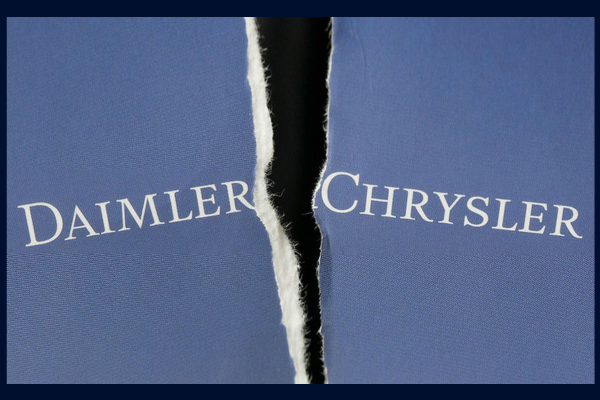
Why the Daimler-Chrysler merger became one of the auto industry’s biggest failures

Michael Olabode Williams by Michael Olabode Williams
June 11, 2026
in Business, Premium
0
the Daimler-Chrysler merger

The Daimler-Chrysler merger

7.8k
SHARES
52.9k
VIEWS
Share on FacebookShare on Twitter

For business leaders, investors and car industry watchers, the Daimler-Chrysler story remains one of the clearest warnings in corporate history. It shows that size alone does not create success. A merger can look powerful on paper but still fail if people, culture and strategy do not work together.

In 1998, Germany’s Daimler-Benz and America’s Chrysler Corporation joined forces to create DaimlerChrysler. The deal was valued at about $36 billion and was presented as a “merger of equals.” The promise was bold: to create a global automotive giant with strength in luxury cars, mass-market vehicles, trucks and sport utility vehicles.

READ ALSO

The 1,100HP Aston Martin Valkyrie is the wildest vehicle in Max Verstappen’s garage

American Airlines, Google sign record 35-million-gallon sustainable aviation fuel deal

Daimler-Benz brought Mercedes-Benz, one of the world’s most respected luxury car brands. Chrysler brought strong American names such as Chrysler, Dodge and Jeep. On paper, it looked like a perfect match between German engineering and American market power.

The ambition was simple. Mercedes-Benz would offer prestige, technology and global credibility. Chrysler would add scale, volume and access to America’s profitable mass-market car buyers.

But the dream soon began to weaken. What looked like a powerful business combination became a difficult relationship between two very different companies. The problem was not only financial. It was cultural, strategic and deeply human.

Daimler-Benz operated with a German corporate style. It was formal, engineering-led, hierarchical and strongly focused on premium quality. Chrysler was different. It was faster-moving, more informal, cost-conscious and built around the realities of the American mass market.

Those differences became serious. The two companies did not behave like one united organisation. They had different ways of making decisions, managing people and building cars.

This meant the expected benefits of the merger did not fully arrive. The companies were supposed to share technology, reduce costs and strengthen each other’s product lines. Instead, integration became slow, difficult and painful.

The second major problem was brand mismatch. Mercedes-Benz served customers who expected luxury, precision and prestige. Chrysler served buyers who wanted value, practicality and strong American styling.

The idea that Mercedes technology could easily improve Chrysler vehicles was too optimistic. Luxury engineering added cost. Many Chrysler customers were not ready to pay more for high-end technology they did not ask for.

DaimlerChrysler’s own leadership later accepted this point. Former chief executive Dieter Zetsche admitted the company had overestimated how much Chrysler buyers would pay for Mercedes-style technology. That misreading damaged the business case behind the merger.

There was also a serious trust problem. Although the deal was sold as a “merger of equals,” many Chrysler executives and workers felt Daimler was in control. That created resentment inside the company.

Once people believe one side has taken over, cooperation becomes harder. Staff become defensive. Leaders protect their own interests. The emotional damage can be as dangerous as the financial cost.

The timing also worked against Chrysler. The company relied heavily on larger vehicles, including SUVs and trucks. These models were profitable when American demand was strong.

But as fuel economy became more important, Chrysler became exposed. Buyers started paying closer attention to running costs, smaller vehicles and efficiency. Chrysler did not move fast enough to protect itself.

The financial impact was severe. Chrysler moved from profit to a major loss. In 2001, the business reportedly lost about €2.2 billion, after making a profit the year before.

By 2007, Daimler had accepted that the marriage had failed. It sold the majority of Chrysler to Cerberus Capital Management for $7.4 billion. That was far below the value attached to the original merger less than a decade earlier.

The result was one of the most painful corporate reversals in modern automotive history. A deal designed to create a global champion ended with separation, disappointment and huge reputational damage.

The Daimler-Chrysler failure offers a simple lesson. A merger does not succeed because two companies are strong separately. It succeeds when their cultures, leadership teams, products and customers can work together.

For the automotive industry, the story remains deeply relevant. Global ambition is important, but ambition without cultural integration can destroy value. Even the strongest brands can suffer when strategy ignores people.

The real failure of Daimler-Chrysler was not that the companies lacked power. It was that they never truly became one company. In the end, the merger proved that business success is not only built in boardrooms. It is built through trust, shared purpose and execution.

Read also: Honda-Nissan merger talks: Can a leadership shake-up revive the deal?

Tags: Around the worldChryslerDaimlerHeadline

Related Posts

Max Verstappen's car collections
Business

The 1,100HP Aston Martin Valkyrie is the wildest vehicle in Max Verstappen’s garage

June 11, 2026
American Airlines
Aerospace

American Airlines, Google sign record 35-million-gallon sustainable aviation fuel deal

June 11, 2026
Uber
Business

Uber sues New York City over driver protection law, warns of safety risks

June 11, 2026
FCAS aircraft collapse
Aerospace

FCAS collapse: €100bn European fighter jet dream ends in industry rift

June 11, 2026
Business

FIFA World Cup 2026: Hyundai sends 1,500 vehicles, robots to run logistics

June 10, 2026
world’s most expensive parking space
Business

World’s most expensive parking space sells for $1.3m in Hong Kong

June 10, 2026
Next Post
cars in Africa

The African Car: Why the continent needs vehicles built for its own reality

POPULAR NEWS

Inferno at Toyota 1000 Desert Race consumes 49 cars

Inferno at Toyota 1000 Desert Race consumes 49 cars

July 3, 2023
Mobius Motors

Mobius Motors: Rising taxes, competition ends Kenyan SUV maker’s journey

August 7, 2024
Autojournal car race

Get ready for the biggest RACE show this December in Nigeria

August 12, 2024
From style to sustainability: How Geely Auto is shaping the future of luxury vehicles

From style to sustainability: How Geely Auto is shaping the future of luxury vehicles

October 25, 2024
Rolls-Royce La Rose Noire Droptail 2026, the most expensive car in 2026

Ultra-luxury: The 10 most expensive cars in the world in 2026

January 7, 2026

EDITOR'S PICK

Vehicle recalls in South Africa

Why Volkswagen, Volvo, Toyota recall nearly 7,000 vehicles in South Africa

July 10, 2025
Fascinating Facts About Pilots

Top 7 facts about pilots you should know

July 11, 2023
The UK’s auto industry

UK auto industry falls 11.9% in toughest year since 1953

July 29, 2025
Boeing 767F

FAA’s new fuel efficiency rules signal end for Boeing 767F production by 2028

February 23, 2024

About

Auto Journal Africa is the leading online and print magazine for automobiles in Africa.

Follow us

Recent Posts

  • The 1,100HP Aston Martin Valkyrie is the wildest vehicle in Max Verstappen’s garage
  • American Airlines, Google sign record 35-million-gallon sustainable aviation fuel deal
  • Uber sues New York City over driver protection law, warns of safety risks
  • The African Car: Why the continent needs vehicles built for its own reality

Links

  • Privacy Policy
  • About Us
  • Contact Us
  • Terms & Conditions
  • News
  • Reviews
  • Events
  • Tools
  • For Sale

© 2023 Auto Journal

No Result
View All Result
  • News
    • Tech
    • Lifestyle
    • Business
    • Opinion
    • Premium
  • Reviews
  • Events
    • Nigeria
    • South Africa
  • Tools
    • Price Guide
    • Find your idea car
    • Car valuation
    • Sell your car
    • Car insurance quote
    • Locate a dealer
    • Deals
  • For Sale
    • New Cars for sale
    • Cheap Cars for sale
    • Bikes for sale
    • Trucks for sale
    • Boats for sale
    • Jets for sale in Africa
    • Cars under 5m
    • EV in Nigeria
    • EV in South Africa

© 2023 Auto Journal

Welcome Back!

Sign In with Google
OR

Login to your account below

Forgotten Password?

Retrieve your password

Please enter your username or email address to reset your password.

Log In
Are you sure want to unlock this post?
Unlock left : 0
Are you sure want to cancel subscription?