
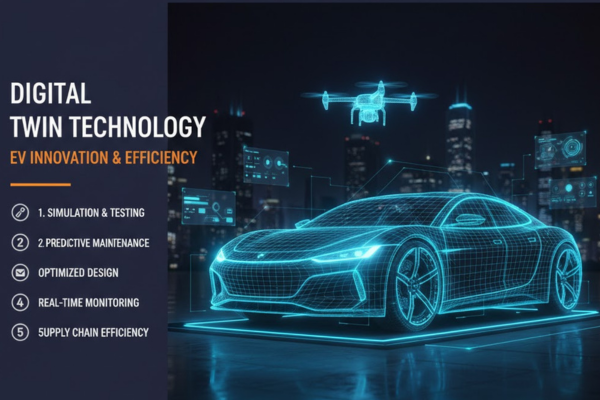
Electric vehicles may look quiet on the road, but behind the scenes, a high-speed digital revolution is reshaping how they are built. As automakers race to cut costs, improve battery performance, and deliver safer cars faster, digital twin technology has emerged as a critical tool, quietly redefining the competitive edge in the global EV market.
Here are five things to know about how digital twins are changing electric vehicles.
1. Digital twins are shrinking EV development timelines
At its core, a digital twin is a living, data-driven virtual replica of a vehicle, component, or factory. By running crash tests, aerodynamic studies, and thermal simulations in the virtual world, automakers are replacing large portions of physical prototyping.
This shift allows EV manufacturers to compress development cycles, reduce tooling costs, and bring vehicles to market faster. Instead of waiting months for physical tests, engineers can simulate thousands of scenarios in parallel, cutting delays without compromising safety or performance.
2. Battery performance and safety are major beneficiaries
Battery reliability remains one of the biggest concerns for EV buyers. Digital twins play a central role in addressing this by modeling battery degradation, heat behavior, and usage patterns over time.
These simulations help engineers extend driving range, manage thermal risks, and improve long-term battery safety. By predicting failure modes before they occur, digital twins directly tackle range anxiety and safety concerns, two key barriers to wider EV adoption.
3. Factories are being virtualized before they are built
Digital twins are no longer limited to vehicle design. Automakers are now creating factory-level twins to simulate entire production lines.
Companies such as BMW, Toyota, and Hyundai use these models to test workflows, robot placement, and material flows before making physical changes. Hyundai’s Metaplant America operates with a central digital twin hub that mirrors production in real time, helping teams identify bottlenecks, reduce defects, and maintain flexibility without halting operations.
4. Predictive maintenance is reducing breakdowns and costs
EVs generate vast amounts of sensor data. When connected to a digital twin, that data enables predictive maintenance, spotting issues before they turn into failures.
For owners, this means fewer unexpected breakdowns and lower long-term maintenance costs. For manufacturers, it reduces warranty claims and improves brand trust. The same feedback loop allows automakers to monitor vehicles after sale, turning after-sales service into a continuous data-driven process.
5. Software and OTA updates are being tested virtually first
As EVs become increasingly software-defined, manufacturers rely on over-the-air (OTA) updates to deploy new features and safety fixes. Digital twins allow these updates to be virtually staged and validated before reaching vehicles on the road.
This reduces the risk of software errors, improves cybersecurity oversight, and ensures smoother updates. In parallel, twins are being used to simulate advanced driver-assistance systems (ADAS) and autonomous-driving edge cases, scenarios too dangerous or rare to recreate physically.
Why it matters
Digital twin technology is no longer experimental. It is becoming the operational backbone of EV programs worldwide, particularly in fast-growing markets across Asia-Pacific.
For automakers, the message is clear: in an industry defined by complexity, software, and speed, the ability to simulate intelligently may matter more than the ability to build quickly. Those that invest early in digital twins are gaining efficiency, reliability, and responsiveness. Those that don’t risk falling behind in an EV market where virtual precision is now a competitive necessity.
Read also: California proposes $200m EV tax rebates amid industry shake-up










![Tesla [Source: Investopedia]](https://autojournal.africa/wp-content/uploads/2024/04/Tesla-Source-Investopedia-120x86.png)