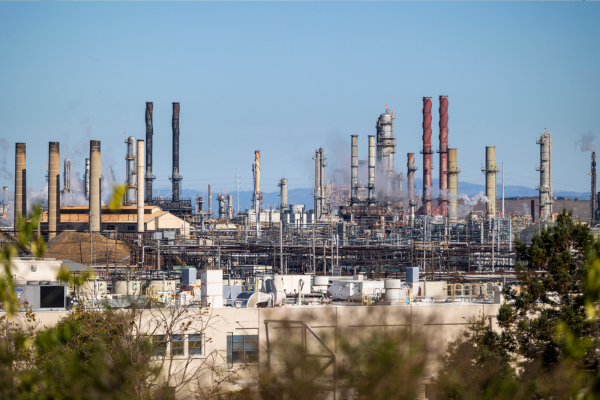
A long-delayed pollution-control project at Chevron’s Richmond refinery in California could help reduce harmful air pollution affecting nearby communities. However, years of legal disputes and environmental reviews have slowed its progress, despite concerns about the health risks facing local residents.
The proposed project involves installing advanced pollution-control equipment known as wet gas scrubbers. The technology is designed to capture harmful particles from refinery emissions before they enter the atmosphere.
The delay has raised concerns among environmental campaigners and residents. According to the Bay Area Air District, pollution from Chevron’s refinery contributes to more than 11 premature deaths annually in surrounding neighbourhoods.
The controversy highlights a wider challenge facing the energy industry: balancing industrial operations, environmental regulations and the health of communities living close to major facilities.
Why Chevron’s pollution-control project matters
The Bay Area Air District approved Rule 6-5 in July 2021. The regulation requires Chevron’s Richmond refinery and Martinez Refining Company to install wet gas scrubbers to meet stricter particulate pollution limits.
However, both companies challenged the regulation in court. Chevron argued that the requirement represented another example of California policies creating a difficult business environment for manufacturers.
The legal disputes contributed to delays in implementing the pollution-control requirements. Both companies eventually withdrew their lawsuits, allowing the projects to move forward through the remaining approval processes.
The proposed scrubbers use a combination of water and sodium hydroxide, commonly known as lye. This mixture helps remove pollutants from refinery exhaust before they are released into the surrounding environment.
Technology licensor Babcock & Wilcox Enterprises says the equipment can be integrated into existing refinery operations. The technology has been available since the 1970s, making it an established approach to industrial emissions control.
Residents face growing concerns over air pollution
The health implications are particularly serious for communities surrounding the Richmond refinery. The Bay Area Air District identifies the facility as Richmond’s largest individual source of fine particulate matter, known as PM2.5.
These microscopic particles can penetrate deep into the lungs and enter the bloodstream. Long-term exposure has been associated with respiratory and cardiovascular diseases, as well as increased risks of premature death.
The district also reports that Point Richmond, an area south of the refinery, experiences pollution levels 3.5 times the threshold that triggers corrective action.
This raises concerns about the potential health risks facing people who live, work and attend school nearby. Environmental campaigners argue that stronger pollution controls are essential to protecting vulnerable communities.
Residents have also questioned whether the proposed solution could create additional environmental problems during construction and operation.
Water and electricity demands raise new questions
One of the biggest concerns involves the amount of water required to operate the proposed scrubber system. According to information provided by Richmond city officials, the equipment would require approximately 370,000 gallons of drinking water daily.
That translates to about 135 million gallons annually, equivalent to approximately 511 million litres. Residents have questioned whether using such large quantities of potable water is environmentally sustainable.
The project has also attracted criticism over its electricity requirements. Communities for a Better Environment estimates that the equipment could consume nearly 16,000 megawatt-hours of electricity annually.
That is equivalent to the annual electricity consumption of roughly 1,300 average US households, using an illustrative household consumption of 12,000 kilowatt-hours.
Environmental campaigners have also raised concerns about construction on potentially contaminated land. They want assurances that excavation, waste disposal and other activities will not expose surrounding communities to additional hazards.
Chevron faces $138 million settlement
The pollution-control controversy forms part of a wider effort to address industrial emissions in the Richmond area.
In February 2024, Chevron and Martinez Refining Company reached a combined $138 million settlement with the Bay Area Air District.
The agreement established a Community Air Quality Fund intended to support improvements across the Richmond area.
Potential projects include cleaner air initiatives, improved public spaces, parks and safer streets. The fund is designed to help address environmental concerns affecting local communities.
However, the settlement does not remove the need for effective pollution controls at the refineries. Residents and campaigners continue to seek improvements that address emissions at their source.
How the city plans to reduce the environmental impact
Richmond officials have outlined several measures intended to reduce the scrubber project’s environmental footprint.
The proposed Isomax Cooling Water Tower could allow Chevron to replace drinking water with recycled water for the scrubber operation. This would help reduce pressure on local potable-water supplies.
The additional electricity required would come from Pacific Gas and Electric (PG&E), rather than increased production from Chevron’s existing cogeneration facility.
The city has also addressed concerns about contaminated soil. Excavated material would be treated as contaminated until laboratory testing confirms otherwise.
Liquid waste would pass through the refinery’s wastewater treatment system before being discharged into San Pablo Bay. Solid waste would either go to approved landfills or be sent to cement kilns for recycling.
Construction activities could begin as early as 6am. However, officials say the noisiest work would take place during normal working hours to limit disruption to nearby residents.
These measures are intended to address concerns about water consumption, electricity demand, construction noise and waste management.
Environmental campaigners demand stronger safeguards
Despite supporting the installation of the scrubbers, environmental campaigners say the project must not create further problems for the community.
Kerry Guerin, a staff attorney, and Shiva Mishek, a programme director, emphasised the importance of properly understanding and managing the project’s environmental consequences.
Their position reflects a wider concern among residents and environmental organisations. Pollution-control investments should improve public health without creating additional environmental damage elsewhere.
Richmond City Council was scheduled to hear public comments about the project’s environmental impacts on 5 November 2026.
The consultation provides an opportunity for residents to question officials, raise concerns and seek further assurances before the project advances.
What this means for the automotive and energy industries
The Chevron dispute offers an important lesson for the wider energy and industrial sectors.
Refineries remain essential to supplying transport fuels, petrochemical products and other materials used across modern economies. However, their operations must also meet increasingly important environmental and public-health responsibilities.
For the automotive industry, refinery emissions are particularly relevant because fuel production forms a major part of the wider transport supply chain.
As governments pursue cleaner transport systems, attention must extend beyond vehicle tailpipe emissions. The environmental impact of producing, processing and distributing fuels also deserves scrutiny.
The transition towards cleaner mobility will require investment across the entire energy value chain. This includes cleaner industrial processes, stronger environmental enforcement and greater accountability from major energy companies.
Ultimately, the Richmond project raises a fundamental question: how long should communities wait for cleaner air when the health risks are already documented?
For residents living near industrial facilities, environmental protection is not simply a regulatory target. It is a matter of public health, safety and quality of life.
Read also: California spends $70m on EV rebates, yet electric car sales keep falling