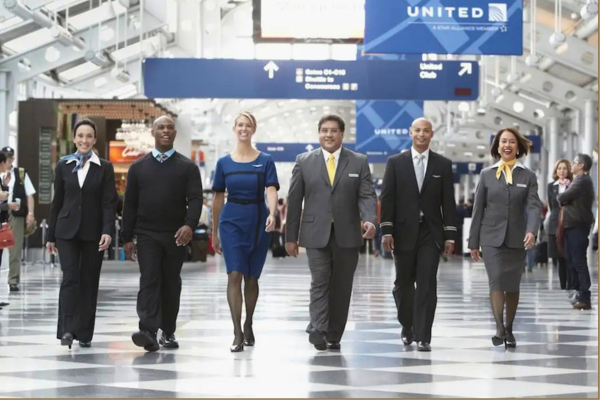
United Airlines passengers on a flight from Edinburgh to Chicago were left outside an airport customs building for about five hours after bad weather forced the aircraft to divert and its crew reached its duty limit.
The incident occurred on July 27 during severe weather around Chicago. The storm produced seven tornadoes and wind gusts above 100 mph, forcing United flight UA119 to divert to Austin Straubel International Airport in Green Bay, Wisconsin.
The Boeing 757-200, which is 29 years old, landed shortly after 2 p.m. Passengers then remained on the aircraft for about four hours while waiting for the flight to continue to Chicago.
Flight Crew Duty Limits Add to Delay
Passenger Heather Fields told ABC7 Chicago that conditions worsened during the wait. “The bathrooms filled up, toilet paper ran low, and food ran out,” Fields said.
The aircraft eventually began taxiing toward the runway. But the crew reached its FAA flight crew duty limit, forcing the aircraft back to the tarmac.
Passengers were then removed from the aircraft. However, they could not enter the terminal because US Customs and Border Protection officers were no longer available to process the international passengers.
United said the officers “were unable to clear customers but allowed them to deplane on the tarmac into a controlled area.”
Green Bay’s CBP office operates from 8 a.m. to 4:30 p.m. on weekdays. Because passengers remained on the aircraft for several hours, they were removed after the office had closed.
Passenger Compensation and Airline Rules
Flight tracking data showed United had scheduled the replacement flight from Green Bay to Chicago for 3:05 p.m. The aircraft eventually departed at 10:19 p.m. and reached Chicago at 10:55 p.m. after a 37-minute flight.
Fields, who was connecting to Denver, said she eventually arrived about 20 hours late. She said United first offered $200 in flight credit before increasing the offer to $500.
US tarmac delay rules require airlines to allow international passengers to leave an aircraft before four hours have passed, provide food and drinking water within two hours, and keep lavatories working.
The case also highlights the operational risks airlines face when weather disruptions, crew duty limits and airport customs operations overlap.
Read also: United Airlines labour contract delivers $741m aviation back pay









![Tesla [Reuters]](https://autojournal.africa/wp-content/uploads/2026/04/Tesla-Reuters-120x86.png)