In early January 2026, winter broke one of Europe’s most important airports.
After six days of snow and freezing winds, KLM warned it was running out of aircraft de-icing fluid at Amsterdam Schiphol Airport. At peak demand, its 25 de-icing vehicles were consuming 85,000 litres of glycol-water mixture per day.
Then the supply chain failed. A German supplier could no longer guarantee deliveries due to extraordinary demand and road closures. KLM sent its own trucks into Germany to collect drums of fluid. Still, more than 600 flights were cancelled in one day.
The crisis exposed aviation’s hidden dependency; if the de-icing fluid stops flowing, planes do not fly.
1. What aircraft de-icing fluid really is
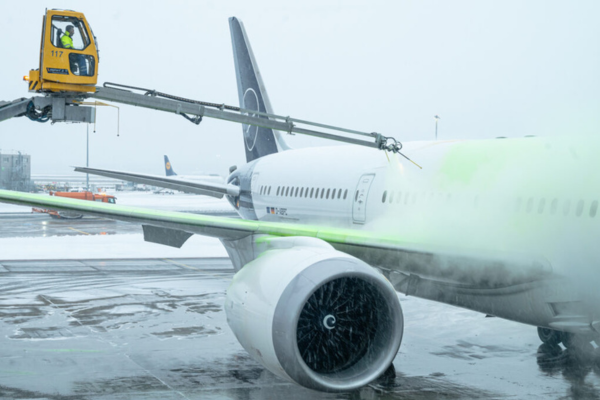
Aircraft de-icing fluid is a chemical safety system. Its main ingredient is propylene or ethylene glycol, which lowers the freezing point of water. Additives help the fluid spread, protect aircraft materials, stick to wings during taxiing, and show crews where it has been applied.
2. The four fluids that keep winter flights moving
- Type I (Orange): Hot, thin fluid to remove ice
- Type II (Clear): Thick anti-icing for large aircraft
- Type III (Yellow): For smaller aircraft
- Type IV (Green): Heavy-duty protection with the longest holdover time
Most winter departures use a two-step process: Type I first, then Type IV.
3. A $1.62 billion market built on safety
The global Aircraft De-icing Fluid market is valued at about $1.87 billion (2026) and is growing at 5–6% annually.
According to Mordor Intelligence, industry leaders include:
- Oshkosh Corporation
- Vestergaard Company
- Global Ground Support LLC
- Weihai Guangtai Airport Equipment Co., Ltd.
- TUG Technologies Corporation (Textron, Inc.)
The market is moderately concentrated, with the top five controlling just under 60% of global sales.
4. The competitive race: Trucks, Software, and Electrification
Competition is no longer just about spraying fluid.
Oshkosh and Vestergaard lead the high-end segment with electric drivetrains and telematics that cut emissions and boost uptime. Oshkosh’s Tempest-i uses a single engine and 39% fewer parts, while Vestergaard’s 7,600-liter e-MY Lite is gaining traction at airports seeking noise and emission reductions.
Textron GSE is targeting 75% electric or hybrid output by 2035, aligning with airport carbon goals. Across the market, digital tools, fluid analytics, predictive maintenance, and compliance dashboards—are becoming key revenue drivers through long-term service contracts.
5. The Environmental Trade-Off
De-icing fluids are biodegradable but create high Biochemical Oxygen Demand (BOD) when they enter waterways, stripping oxygen from aquatic life.
Airports are responding with airport de-icing infrastructure, including runoff capture, recycling plants, and pad-based treatment systems.
6. Geography: Where demand is anchored
North America generated 62.75% of 2024 revenue, driven by dense hubs, harsh winters, and strict FAA oversight. Syracuse Hancock International Airport’s $19.4 million glycol-recycling plant can reclaim fluid with glycol concentrations as low as 0.25%, producing up to 550,000 gallons annually.
Europe ranks second, shaped by EASA rules and the European Green Deal. Airports in Scandinavia and the Alps continue investing in capture systems and remote pads.
Asia-Pacific is the fastest-growing region, with a 6.84% CAGR, as China, South Korea, and Japan expand winter operations and purchase de-icing fleets for the first time.
7. When De-icing Fails, Everything Stops
The KLM crisis showed the domino effect:
- Millions lost to cancellations and reactionary delays
- Cargo supply chains disrupted
- Airport systems overwhelmed by stranded passengers
Modern aviation still depends on basic chemistry and a stable supply of glycol.
Read more on KLM faces de-icing fluid shortage as winter storms disrupt Schiphol Airport