
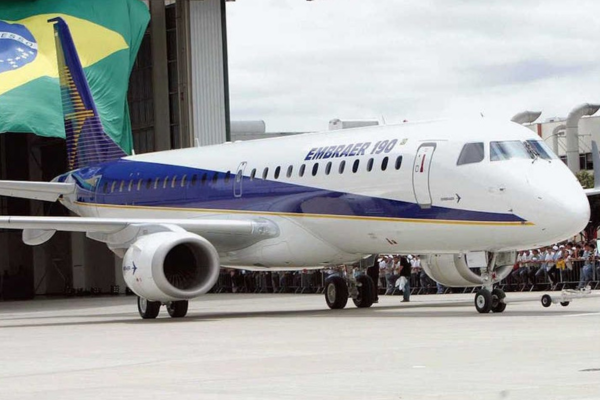
Business travellers could soon experience quieter cabins, smarter seating and more personalised comfort on private jets, as Brazilian aircraft maker Embraer unveils a redesigned generation of executive aircraft aimed at reshaping mid-size aviation.
The company has launched two upgraded business jets designed to deliver long-range performance at lower operating costs than larger aircraft. The new models promise improved passenger wellbeing, advanced digital controls and interiors usually found only on ultra-long-range private jets costing far more.
Industry experts say the move could intensify competition in one of aviation’s fastest-growing markets. Super-midsize jets remain popular because they combine intercontinental range with lower fuel burn and reduced crew costs.
A rare clean-sheet rethink
Most business jets evolve slowly because development and certification can cost billions of dollars. Manufacturers typically upgrade engines or avionics while keeping existing cabin layouts largely unchanged.
This launch signals a different approach. The aircraft build on an earlier platform introduced in 2018 but introduce a redesigned cabin concept focused on passenger experience rather than structural change.
The announcement follows a demonstration flight attended by journalists from Robb Report at the company’s executive aviation headquarters in Melbourne, Florida.
Turning cabins into living spaces
Executives say the goal was simple: make mid-size jets feel like larger aircraft without increasing cabin size or operating costs.
“We asked how to unlock the full potential of the category,” said Alvadi Serpa Junior, the firm’s vice-president for market and product strategy.
One headline feature is a 42-inch curved digital display integrated into the cabin wall and co-developed with Lufthansa Technik. Connected to external cameras, it can display live exterior views, video calls or entertainment, effectively replacing a traditional bulkhead divider.
Design chief Jay Beever said the system creates a third social zone inside the aircraft without increasing physical space. Passengers seated nearby gain a shared viewing and interaction area, transforming how cabins are used during flight.
Seats designed for long journeys
The biggest improvement may be the seating itself. Engineers developed fully electric seats without traditional mechanical levers, allowing instant adjustment through armrest controls.
Passengers can fine-tune lumbar support, cushioning levels and recline angles. Seats swivel easily for meetings, dining or rest, and convert into sleeping berths for longer flights.
Cabin ergonomics also received attention. New air-distribution panels replace traditional adjustable vents, delivering airflow through slim slots controlled by touch panels or mobile apps. Engineers say the redesign improves comfort while reducing cabin clutter.
Lighting, comfort and technology
A programmable lighting system offers up to 16 million colour combinations. Passengers can adjust ambience using voice commands, matching time zones, activities or personal preference.
Exterior cameras feed live imagery to cabin monitors, helping reduce the closed-in feeling often experienced during long flights. A redesigned galley provides more preparation space for crew, while a forward lavatory improves operational efficiency.
Range and pricing
The larger aircraft offers a range of about 4,108 nautical miles, allowing nonstop routes such as London to New York or Dubai to Singapore under favourable conditions. The manufacturer also says payload capacity has increased, enabling more passengers or luggage on longer trips.
The smaller sibling shares most interior upgrades but omits the large digital window due to space limitations.
Prices reflect modest increases despite extensive redesign work. The midsize version starts at roughly $21.6 million (£17 million), while the larger aircraft begins at about $25.8 million (£20 million). Deliveries are expected to begin in 2029.
Industry impact
Analysts believe the aircraft could push rivals to rethink cabin design across the segment. Features once reserved for the most expensive jets are moving into more accessible categories, potentially reshaping customer expectations.
For passengers, the shift means fewer compromises between cost and comfort, and a private jet experience increasingly defined by wellbeing, connectivity and flexibility rather than sheer size.
Read also: Embraer rides private jet boom to 103% delivery surge with 61 aircraft in Q2 2025
![Tesla [Reuters]](https://autojournal.africa/wp-content/uploads/2026/04/Tesla-Reuters-350x250.png)













![Luxury cars in Russia [Reuters]](https://autojournal.africa/wp-content/uploads/2026/02/Luxury-cars-in-Russia-120x86.png)