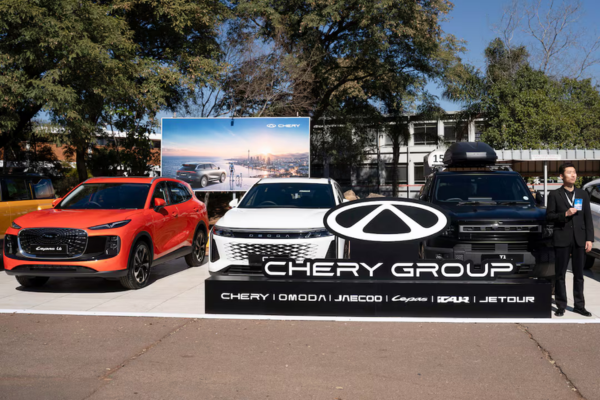
South Africa’s automotive industry is preparing for a major boost after Chinese car giant Chery officially took control of Nissan’s former vehicle manufacturing plant in Rosslyn, Pretoria. The investment promises new jobs, stronger local manufacturing and a bigger role for South Africa in the global automotive supply chain.
The move marks one of the most significant Chinese automotive investments in Africa in recent years. Chery plans to transform the former Nissan facility into its main African manufacturing, export, research and development hub, reinforcing the continent’s growing importance in the global vehicle industry.
The handover ceremony took place on Friday, six months after the agreement was first announced in January. Company executives, government officials and industry leaders gathered at the Rosslyn facility to celebrate the beginning of a new era for one of South Africa’s best-known automotive plants.
Chery, currently China’s largest vehicle exporter, confirmed it will invest millions of dollars to modernise the factory before production begins in the middle of 2027. Although executives declined to reveal the exact investment figure, the company said extensive upgrades will include new machinery, improved utilities and advanced manufacturing equipment.
The investment also provides reassurance for workers. Chery has committed to retaining all 692 employees currently working at the Rosslyn factory, ensuring continuity while preparing the facility for future expansion.
Beyond protecting existing jobs, the company expects the project to create nearly 3,000 direct and indirect employment opportunities across vehicle manufacturing, logistics, supplier networks and related services. The expansion is expected to strengthen South Africa’s position as the continent’s largest automotive manufacturing hub.
“Our long-term goal is to turn the Rosslyn plant into a complete automotive centre,” said Chery Auto Vice President Charlie Zhang.
He said the facility would eventually include vehicle production, research and development, supply chain operations and technical training centres. The broader ambition is to support Chery’s growing African presence while helping the company exceed annual sales of 100,000 vehicles in South Africa.
Production will initially focus on several of Chery’s fastest-growing sport utility vehicles. These include the Jetour T Series, the Jaecoo J5 and the Chery Tiggo 4. The Jaecoo J5 will be available in both traditional petrol-powered and new energy vehicle versions, reflecting rising demand for electrified transport across global markets.
During the production ramp-up planned for the third and fourth quarters of 2027, Chery expects the Rosslyn plant to manufacture around 15,000 vehicles. Production volumes are expected to increase steadily as demand grows across South Africa and export markets.
The company has also launched a localisation programme aimed at achieving 40% locally sourced components during the first stage of production. Executives confirmed discussions are already underway with major Tier 1 suppliers to establish stronger local supply chains.
Alongside local sourcing, Chery intends to introduce selected suppliers from China, particularly those specialising in electric vehicle technologies and intelligent vehicle systems. The strategy combines international expertise with local industrial development, creating opportunities for technology transfer and skills development.
The investment reflects a wider trend across the global automotive industry. Chinese manufacturers are rapidly expanding overseas as competition intensifies in their domestic market and production capacity continues to grow. Africa has become an increasingly attractive destination because of its expanding consumer market, improving manufacturing capabilities and strategic access to international export routes.
For South Africa, the project represents far more than a factory ownership change. It signals renewed confidence in the country’s automotive sector at a time when global manufacturers are competing to establish regional production bases closer to emerging markets.
If Chery delivers on its long-term ambitions, the Rosslyn facility could become one of Africa’s most important automotive manufacturing centres, helping create thousands of jobs, attract new suppliers and position South Africa at the heart of the continent’s transition towards next-generation mobility.
Read also: Volkswagen crisis deepens as China profits collapse and stock hits 15-year low
![Tesla [Reuters]](https://autojournal.africa/wp-content/uploads/2026/04/Tesla-Reuters-350x250.png)