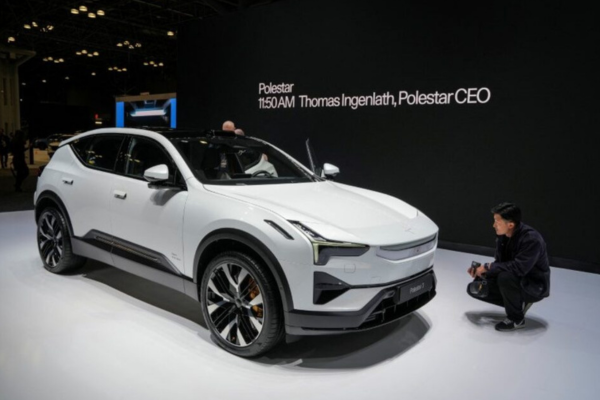
Polestar customers in the United States may soon have fewer electric vehicle choices.
The Swedish electric carmaker says it will be blocked from selling new vehicles in the US from the 2027 model year. The decision is linked to Washington’s growing concern over connected car technology tied to China.
Polestar is majority-owned by China’s Geely Holding. That ownership structure has placed the company directly in the path of new US restrictions aimed at protecting national security and sensitive driver data.
The rule covers connected vehicle systems such as Bluetooth, Wi-Fi, cellular links and some satellite communication technologies. US officials fear such systems could collect data from American drivers and send it to foreign-linked companies.
The Connected Vehicles Rule was introduced in January 2025 under former President Joe Biden. It has remained in place under President Donald Trump, as the US continues to take a harder line on Chinese-linked vehicles and technology.
Polestar said the US Commerce Department did not grant it authorisation to continue selling cars under the rule. The company also said it would not appeal the decision.
The announcement hit investor confidence. Polestar shares fell by 6.3% on the Nasdaq on Thursday afternoon.
For American buyers, the immediate impact may be limited. Polestar says it will continue to sell existing Polestar 3 and Polestar 4 vehicles already available in the country. It will also keep its US service network open for customers.
However, the longer-term picture is more uncertain.
The ruling raises fresh questions about the future of the Polestar 3. It is currently the brand’s only model built in the United States.
Volvo Cars, which produces some Polestar models, had earlier said it planned to focus Polestar 3 production at its South Carolina plant. The car had also been built in Chengdu, China.
Volvo said production in China had not yet stopped. It also said it was too early to know whether the US decision would affect future production plans.
Polestar had already warned in 2024 that the connected vehicle rules could effectively stop it from selling cars in America. That warning now appears to be becoming reality.
The company’s US exposure is relatively small. Only 6% of Polestar’s first-quarter sales came from the United States.
Europe is far more important to the company. The region accounted for 78% of Polestar’s first-quarter sales, making it the brand’s main growth market.
Polestar Chief Executive Michael Lohscheller said the global car industry was moving into a new regional phase. He said the company’s strategy now reflects that shift, with Europe becoming its biggest growth engine.
The company also plans to build its future Polestar 7 compact SUV in Europe. Production is expected to take place at Volvo’s planned factory in Slovakia.
The US decision comes at a difficult time for Polestar. The company has struggled to become profitable and has relied on repeated financial support from Geely and Chairman Li Shufu.
Its share price has also come under pressure. Last year, Polestar had to carry out a reverse stock split to keep its Nasdaq listing.
The wider industry is now watching closely. Other carmakers are trying to secure US authorisation for models that have been sold in American showrooms for years.
Volvo Cars, Polestar’s sister brand and co-founder, said in May that it had received authorisation. However, it still needs to ensure its US lineup complies with the rule.
The Polestar decision shows how quickly electric vehicles have become part of a larger political battle. What began as a race for cleaner transport is now also a fight over data, security and industrial power.
For drivers, this could mean fewer EV options and higher uncertainty around future models. For carmakers, it is a warning that technology, ownership and supply chains now matter as much as design, range and price.
Polestar’s future in America is not over. But from the 2027 model year, its road ahead in the US has become far more difficult.
Read also: BYD’s Great Han spotted as China’s EV race moves into five-minute charging

![Tesla [Reuters]](https://autojournal.africa/wp-content/uploads/2026/04/Tesla-Reuters-350x250.png)