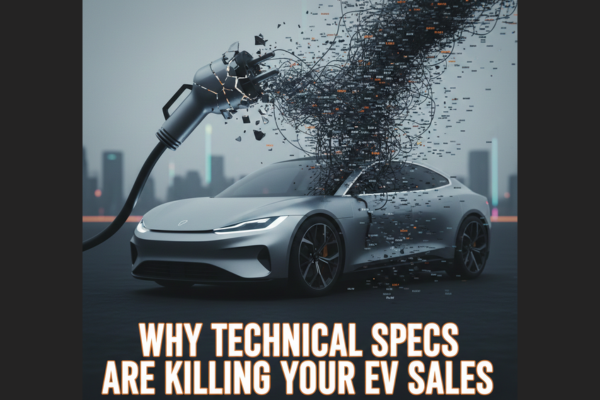
Your EV range is impressive but it can also be why you are not making sales and losing market share. The electric vehicle market is entering its commoditisation phase and too many brands are fighting a performance war while quietly losing the emotional battle that actually drives purchasing decisions.
In today’s EV ecosystem, leading with “400 miles of range” doesn’t sell freedom. It invites comparison.
The moment you reduce your value proposition to kilowatt-hours, 0–60 times, and charging speed, you tell the customer to judge your offer based on price-per-mile and price wars have no winners.
This is how strong brands turn themselves into interchangeable hardware. A competitor adds 10 extra miles for $1,000 less, and years of engineering investment evaporate in a single browser tab.
This is the data-heavy trap:
- 350-mile range. 150kW fast charging. 0–60 in 3.8 seconds. Starting at $55,000.
The outcome is predictable. Buyers stop listening to you and start benchmarking you.
Contrast that with a story-led strategy:
- “No engine noise, fuel stops. Just a quiet drive at dawn with your children and nowhere you need to rush to. Begin every week with a full tank of time.”
Now you’re not selling a battery, time, calm, and legacy and this is where premium margins live.
Multiple consumer studies show that people are significantly more likely to remember, and pay more for brands that communicate through narrative rather than raw specifications.
As EV technology converges and supply chains mature, storytelling becomes the only defensible moat left. Engineering excellence is no longer enough.
The EV winners of 2026 will be the brands that stop selling how the product works and start selling why it belongs in the customer’s life.
Because in the end, people don’t fall in love with batteries. They fall in love with what batteries make possible.
Read more on New AI system detects EV battery fires before they start