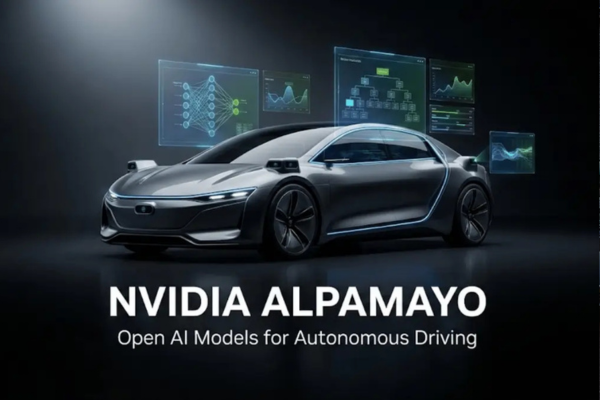
Nvidia, the world’s leading chip-maker, unveiled Alpamayo, a new platform for self-driving cars at CES 2026, signaling a major push to embed AI into physical products.
The system promises to bring “reasoning” to autonomous vehicles, allowing them to navigate complex environments, respond to rare scenarios, and explain their driving decisions. Speaking at the CES conference, CEO Jensen Huang said the technology aims to make cars safer and smarter, marking what he called a “ChatGPT moment for physical AI.”
Mercedes-Benz Driverless Car to Hit US Roads
Nvidia confirmed a partnership with Mercedes-Benz, with plans to launch a driverless car in the US before expanding to Europe and Asia. A video demonstration showed the AI-powered Mercedes navigating San Francisco streets while the passenger kept their hands in their lap, highlighting the system’s human-like decision-making.
From Chips to Full AI Ecosystems
Traditionally a chip designer, Nvidia is pivoting toward becoming a platform provider for physical AI systems. Analyst Paolo Pescatore said Alpamayo represents a “profound shift,” enabling Nvidia to maintain its edge over rivals. The model’s open-source code is now on Hugging Face, allowing researchers to retrain it for autonomous vehicle applications.
Investor Spotlight: Nvidia Market Cap and Growth
Nvidia remains the world’s most valuable publicly traded company, with a market capitalization of $4.5 trillion, reflecting strong investor confidence despite recent concerns about AI hype. Huang also previewed the upcoming Rubin AI chips, which promise lower energy consumption and reduced costs for autonomous vehicle development.
Tesla Competition and Future Ambitions
The project could challenge Tesla’s Autopilot. Elon Musk acknowledged the difficulty in perfecting driverless systems, noting the “long tail” of rare scenarios. Nvidia also plans to launch a robotaxi service next year, though partners and locations remain undisclosed.
Read more on New AI system detects EV battery fires before they start