Author: Ijaseun Isaiah
No airline, no matter how large, can fly everywhere alone.
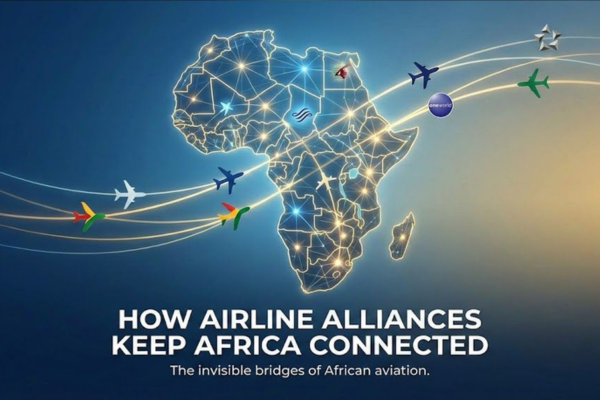
Even the world’s biggest carriers depend on partnerships to extend their reach, share costs, and keep passengers moving seamlessly across continents. And nowhere is this more important than in Africa, where geography, infrastructure gaps, and fragmented markets make collaboration not just useful, but essential.
Behind the scenes of your next flight, there’s a quiet network at work.
An airline alliance is a strategic partnership. Rather than each airline attempting to cover every route on its own, multiple carriers collaborate,sharing passengers, coordinating schedules, and pooling operational resources to extend their reach more efficiently.
Globally, three major alliances dominate the skies, namely Star Alliance, SkyTeam, and Oneworld.
Airlines are sharing reservation systems, aligning schedules, and linking frequent-flyer programs so passengers can move across multiple carriers as if they were flying one.
But in Africa, these partnerships go far beyond convenience. They are often the difference between isolation and connectivity, between survival and growth.
Take Ethiopian Airlines, widely regarded as Africa’s most successful carrier. Rather than relying solely on Addis Ababa, it built a network of partner airlines across the continent.
These include:
- ASKY Airlines in Togo,
- Malawi Airlines,
- Zambia Airways, and
- Air Congo.
This multi-hub strategy connects smaller African cities to major intercontinental routes, feeds passengers into long-haul flights, and strengthens regional aviation networks that might otherwise struggle to survive.
Another example is the growing cooperation between Kenya Airways and South African Airways.
By aligning fleets, routes, and technical expertise, the two carriers are working toward a stronger pan-African network, one capable of competing with large international airlines that dominate long-haul traffic into and out of the continent.
These partnerships are not just corporate strategies. They are the invisible bridges connecting African cities, businesses, and people.
They make it possible to travel from smaller regional airports to global destinations on a single ticket.
They help airlines share risks in volatile markets. And they create the backbone of a more integrated African aviation ecosystem.
The future of African aviation will not be built by isolated carriers competing alone.
It will be built by networks, by alliances, joint ventures, and smart partnerships that connect the continent from the inside out.
Because in aviation, as the industry has proven time and again, no airline goes far alone.
Read also: American Airlines marks 100 years of flight with centennial livery, premium offerings